
Holiday Inventory Checklist for Small Retail Shops
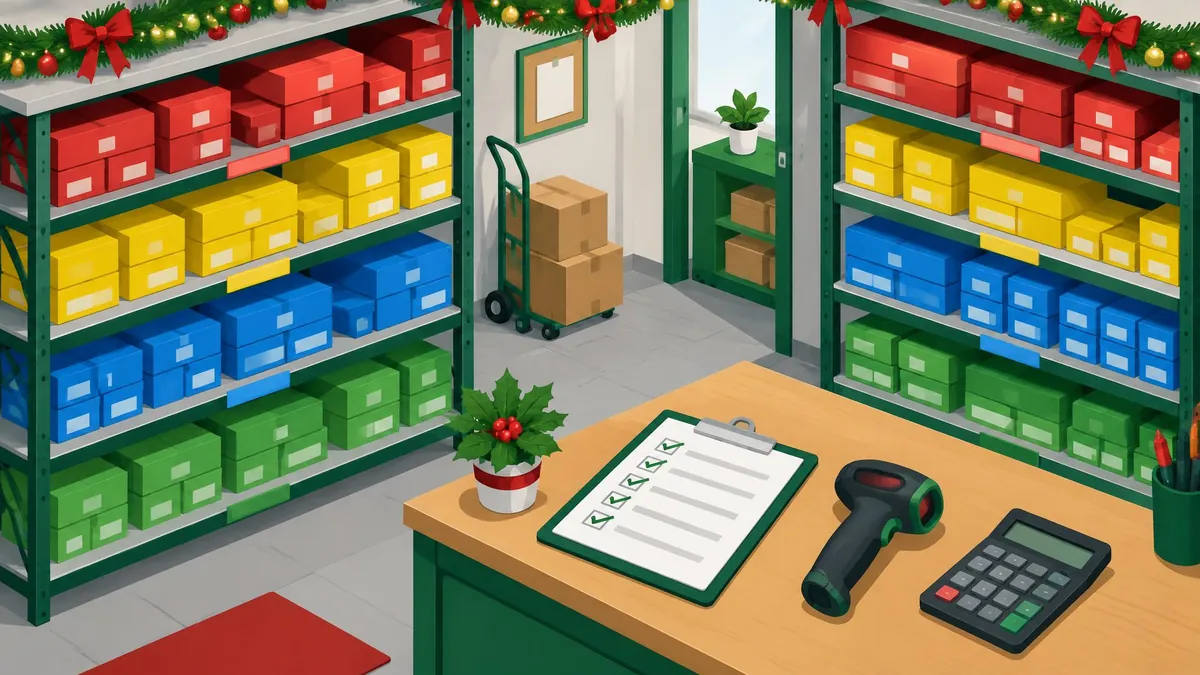
A step-by-step operating checklist to prepare seasonal stock without overlooking cash flow, receiving checks or unsold goods.
Prepare holiday inventory by counting usable stock, checking recent sales, confirming supplier lead times and setting a cash limit before placing orders. Then decide how you will receive goods, update availability, handle returns and reduce leftover seasonal stock. The goal is not the fullest possible storeroom; it is having sellable products when customers need them without tying up money the shop needs elsewhere.
This checklist is intended for small retailers worldwide. The SBA and IRS resources cited are U.S. sources; they support the planning and recordkeeping discussion but do not establish tax or accounting rules for other countries. Follow local requirements and your accountant’s advice for formal inventory valuation.
1. Count what you can actually sell
Start with a physical check rather than assuming the stock record is correct. Separate saleable items from damaged goods, customer reservations, display stock that cannot be sold, and products waiting for a return decision.
Record each item’s identifier, description, variation, location and quantity. Count sizes and colors separately if they are separately sold. A total for an entire product family may hide a shortage in the variation customers actually want.
For discrepancies, recount before adjusting the records. Note the reason if you can establish it: an unrecorded delivery, a misplaced item or a return awaiting inspection. Do not turn an unexplained difference into a confident explanation merely to close the task.
2. Review demand without copying last year blindly
Compare recent sales with the most relevant previous period. Look at units as well as revenue: a price change can make sales value look stronger without any increase in demand.
Ask:
- Which products sold steadily rather than only during a promotion?
- Which products appeared weak because they were out of stock?
- Which purchases were tied to a one-off event?
- Which returns reduced the apparent success of a product?
- Has your range, location, customer base or selling channel changed?
Create a cautious base plan and a higher-demand alternative. Label assumptions clearly. SBA’s planning guidance recommends examining demand, pricing, location and competition; those questions are useful when deciding whether past demand still represents your present market. (SBA)
3. Set a purchasing limit around cash commitments
List supplier payments alongside rent, payroll, delivery charges and other expected bills. Include the dates when money leaves the business, not only the total purchase cost.
SBA’s finance guidance emphasizes bookkeeping, balance sheets and cash-flow planning. A profitable-looking season can still create pressure if suppliers must be paid before customers pay you. Use a cash schedule to decide how much inventory the shop can safely fund. (SBA)
Avoid committing the full purchasing budget immediately if replenishment is feasible. Keep some flexibility for proven demand, unexpected delays or an essential replacement order. The right reserve depends on your business; there is no universal holiday-stock percentage in this checklist.
4. Confirm suppliers and delivery dates
Get important details in writing before sending an order:
- Product and variant identifiers.
- Quantity, case size and minimum order requirements.
- Unit price, freight and relevant additional charges.
- Payment terms and deposit requirements.
- Expected dispatch and arrival dates.
- Procedures for missing, damaged or substituted goods.
- Cancellation and supplier-return conditions.
Distinguish an estimated dispatch date from an arrival commitment. If a product is seasonal, decide the latest useful arrival date and tell the supplier. A shipment delivered after demand has passed can be technically complete but commercially unhelpful.
Identify a backup for the most important lines. Compare substitute specifications and costs before an emergency, not while a customer waits at the counter.
5. Decide what triggers a reorder
For each important product, define who reviews stock and when. A simple starting calculation is expected demand during the replenishment lead time plus a separately chosen buffer. Treat that as a planning aid, not an automated guarantee.
Check both on-hand and already-ordered quantities before buying more. Also account for reserved units and orders you have not yet fulfilled. Keep a note of unusually large customer orders so they are not mistaken for ordinary recurring demand.
Set a final reorder date for short-lived seasonal products. After that point, consider a smaller quantity, a substitute or a transparent out-of-stock message rather than risking a late surplus.
6. Check margin before advertising a promotion
Review cost and selling price after considering the discount, packing, relevant delivery costs and selling fees. Use the profit margin calculator for profit, margin and markup based on the values you enter. It does not know your full business costs unless you account for them.
Use the discount calculator when checking a proposed percentage reduction or an additional sequential discount. It excludes taxes and delivery. Keep those separate when assessing the final customer total and the shop’s economics.
A popular promotion is not automatically a profitable one. Set the minimum acceptable outcome before announcing an offer, including how you will handle unsold promotional stock.
7. Organize receiving and storage
Assign someone to match deliveries with the order and supplier invoice. Record shortages and damage promptly, following supplier procedures. Keep goods that need checking separate from sellable stock.
Give each product a consistent location. Keep aisles and exits clear, and follow product-specific storage requirements. Make fast-moving stock easy to reach without creating unsafe stacks or blocking access to slower-selling lines.
If you use barcodes, test that each label retrieves the correct item, variation and selling price in your actual checkout system. A readable code is not enough if it points to the wrong record. Do not introduce a new labeling process across the entire shop without first testing a small batch.
8. Keep an audit trail through returns and leftovers
Retain purchase invoices, sales records, supplier credits and records of stock adjustments. The IRS identifies invoices, receipts, paid bills and other supporting documents as evidence for business-book entries; its guidance also says electronic records must meet the same basic recordkeeping principles as paper records. Those are U.S. requirements, not a worldwide retention schedule. (IRS)
IRS Publication 334 discusses inventories and small-business accounting exceptions in a U.S. tax context. Do not infer that every retailer everywhere must use one valuation method. Ask a qualified local adviser before changing accounting treatment or writing down leftover stock. (IRS)
Final handover checklist
Before the busiest period, confirm that someone owns each task: stock counts, reorders, supplier follow-up, price updates, receiving, returns and cash review. Keep one current record rather than several conflicting lists.
How much extra stock should a small shop buy?
There is no universal percentage. Use actual demand, lead time, supplier reliability, available cash and the risk of leftovers.
Should every seasonal item be reordered?
No. Compare the likely arrival date with the remaining selling period before committing more cash.
Are the IRS rules global?
No. The cited IRS material concerns U.S. tax and recordkeeping. Use local advice for legal requirements.
Frequently asked questions
How much extra inventory should a shop buy?
There is no universal percentage; use demand, lead time, cash availability and leftover risk.
When should seasonal reordering stop?
Set a latest useful arrival date and compare it with the supplier lead time before ordering.
Do IRS inventory rules apply worldwide?
No. IRS guidance concerns U.S. requirements; follow local rules and qualified advice elsewhere.
Useful on MayreDukaan
Sources
Facts last checked against these sources on 16 Nov 2026, 06:47 Pakistan time.
Images: Illustration created for MayreDukaan (not a photo)
More trending articles
 PDF and Document ToolsAdd Page Numbers to a PDF Without Covering Content16 Nov 2026 · 5 min read
 PDF and Document ToolsExtract Images from PDFs Without Saving Whole Pages16 Nov 2026 · 5 min read
 PDF and Document ToolsPDF to JPG: Convert Pages Without Losing Detail16 Nov 2026 · 5 min read
 International EntertainmentWhere to Watch TV Series: Find Legal Platforms16 Nov 2026 · 3 min read