
Faceted Navigation SEO: Choose Crawlable Filters
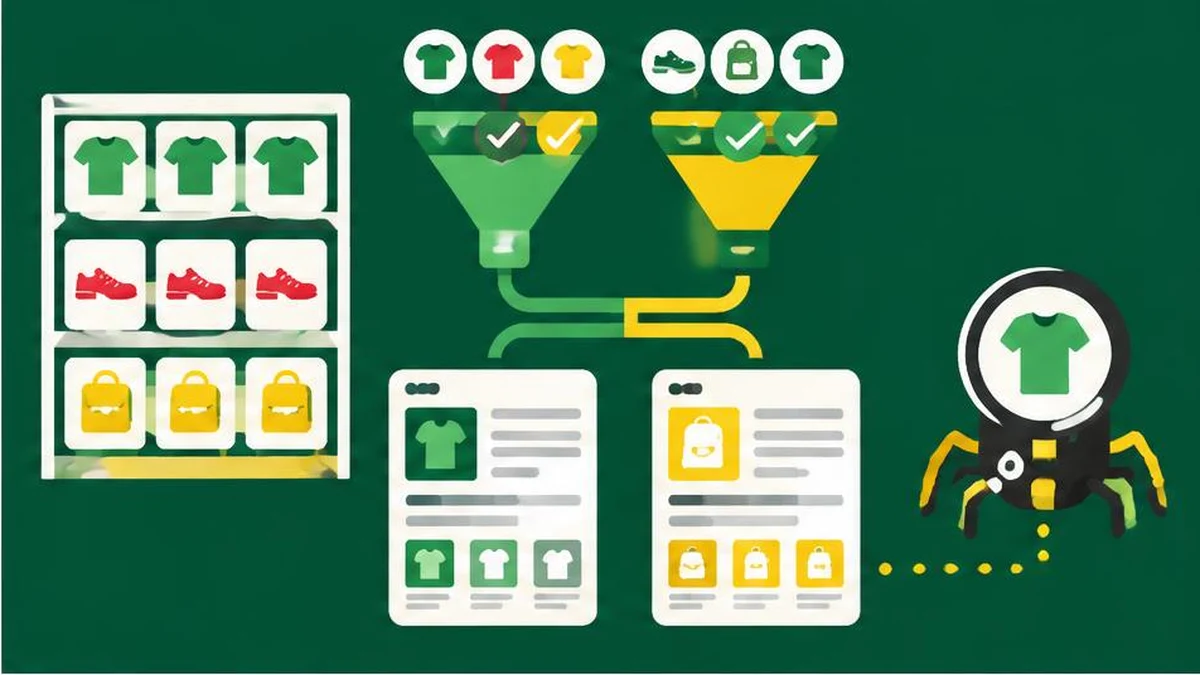
Build a filter-URL policy around useful landing pages and bounded combinations, rather than treating every size, colour and sort order as a new search page.
Start with the URL space, not a robots rule
A shop filter can be useful to a customer without deserving a separate search landing page. Colour, size, brand, price and sort controls can combine into a very large set of URLs. Google’s faceted-navigation guidance warns that parameter-based filtering can create excessive crawling and slow discovery of useful content.
The practical task is to decide which filtered views should be discoverable and which are only interface states. That decision comes before generating a robots file. This guide concerns filter combinations and crawl allocation, not a general introduction to robots.txt syntax or a promise that selected pages will rank.
Inventory the controls that create URLs
Open representative category pages and change one control at a time. Record the resulting URL, whether products change, whether ordering changes and whether additional controls can be combined indefinitely. Include reset links and pagination within filtered results.
A useful audit distinguishes these cases:
| URL type | Question to answer |
|---|---|
| Main category | Does it expose the intended product set? |
| Useful filter landing page | Is this a stable, meaningful subset? |
| Sort-only view | Does it merely reorder the same items? |
| Empty combination | Does it return an appropriate not-found response? |
| Repeated or invalid filter | Can the system generate nonsense URLs? |
Do not infer the policy from the number of parameters alone. A single poorly constrained parameter can create many URLs, while a limited, deliberately managed filtered page may serve a genuine user task.
Decide what deserves crawl access
For each proposed crawlable subset, explain its purpose in ordinary language. A durable category subdivision is different from every possible price-slider position. Consider whether the page remains useful, whether products can be reached through it and whether its URL is stable.
Google recommends preventing crawling of faceted URLs when those URLs do not need to appear in search. Its documentation also describes fragment-based filtering as an option for filter states that do not need independent crawling. Do not use that option for pages you actually want Google to discover as distinct indexable content.
If your team chooses a limited set of crawlable landing pages, document that set explicitly. Keep a clean route to the underlying product pages. The policy should reduce accidental URL proliferation without hiding the only links to important stock.
Make crawlable filter URLs predictable
Google’s guidance recommends standard parameter separators and a consistent logical order when filters are encoded in paths. It also recommends appropriate 404 responses for combinations with no results, duplicate filters, nonsensical combinations and nonexistent pagination URLs.
The URL encoder and decoder can help inspect encoded parameter values. Encode values deliberately; do not encode a complete URL so that its meaningful separators stop functioning. The tool does not decide whether a filtered page should be indexed.
Follow the ecommerce URL-design documentation when defining stable URL patterns. Do not allow arbitrary permutations to create endless equivalent routes just because the application can render them.
Separate crawl prevention from removal
Robots.txt controls crawling; it is not a reliable instruction to remove an already known URL from search. A page-level noindex instruction needs to be accessible to the crawler so it can be read. If a cleanup requires removing already indexed filtered pages, plan that transition separately instead of immediately blocking the URLs that contain the removal instruction.
The robots.txt generator can help prepare rules after the policy is settled. Test the proposed patterns against both unwanted combinations and URLs that must remain available. A broad rule matching a common parameter name can affect more pages than the author intended.
Canonical signals are also not a substitute for a bounded URL design. Google notes that canonical and nofollow approaches may be less effective for long-term crawl control than the approaches it recommends for preventing unwanted faceted crawling. Do not label every filtered subset a duplicate without checking whether the content genuinely matches.
Review a release with explicit examples
Prepare a before-and-after test set containing a category, an approved filtered page, a sort URL, an empty combination and an invalid repeated filter. Record the expected status, crawl access and indexing intention for each.
Use text compare to inspect changes in the written policy or proposed robots rules. Then test the deployed responses with appropriate developer and Google tools; a text comparison cannot prove runtime behaviour.
After deployment, monitor actual crawling and discovery rather than declaring success from a smaller rule file. Investigate accidental blocks and newly generated parameter patterns. This is ongoing URL management: it can make the site more coherent and reduce wasted work, but it does not guarantee indexing, traffic growth or a search position.
Frequently asked questions
Should every filter be indexed?
No. Decide which stable subsets merit separate discovery and which are only interface states.
Does robots.txt remove indexed filters?
Not reliably. Crawl blocking and search removal are different tasks.
Can I block a page and rely on its noindex?
A crawler must access the page to read noindex; plan removal before blocking access to that instruction.
What should an empty combination return?
Google’s faceted-navigation guidance recommends an appropriate 404 for combinations with no results and other nonsensical routes.
Does a canonical stop all crawling?
No. Google describes limitations of canonical signals for long-term faceted crawl control.
Useful on MayreDukaan
Sources
- developers.google.com — faceted-navigation
- developers.google.com — designing-a-url-structure-for-ecommerce-sites
Facts last checked against these sources on 17 Nov 2026, 06:44 Pakistan time.
Images: Original AI-generated illustration by MayreDukaan; conceptual, not a product screenshot.
More trending articles
 Shopping and DealsUK Fake Online Shops: Check the Seller Before Paying17 Nov 2026 · 5 min read
 AI and SoftwareVerify an AI Summary Against the Original Document17 Nov 2026 · 5 min read
 Artificial IntelligenceGemini Activity Privacy: History, Training and Deletion17 Nov 2026 · 5 min read
 AI and SoftwarePrepare a Spreadsheet for Safer Gemini Analysis17 Nov 2026 · 4 min read