
Verify an AI Summary Against the Original Document
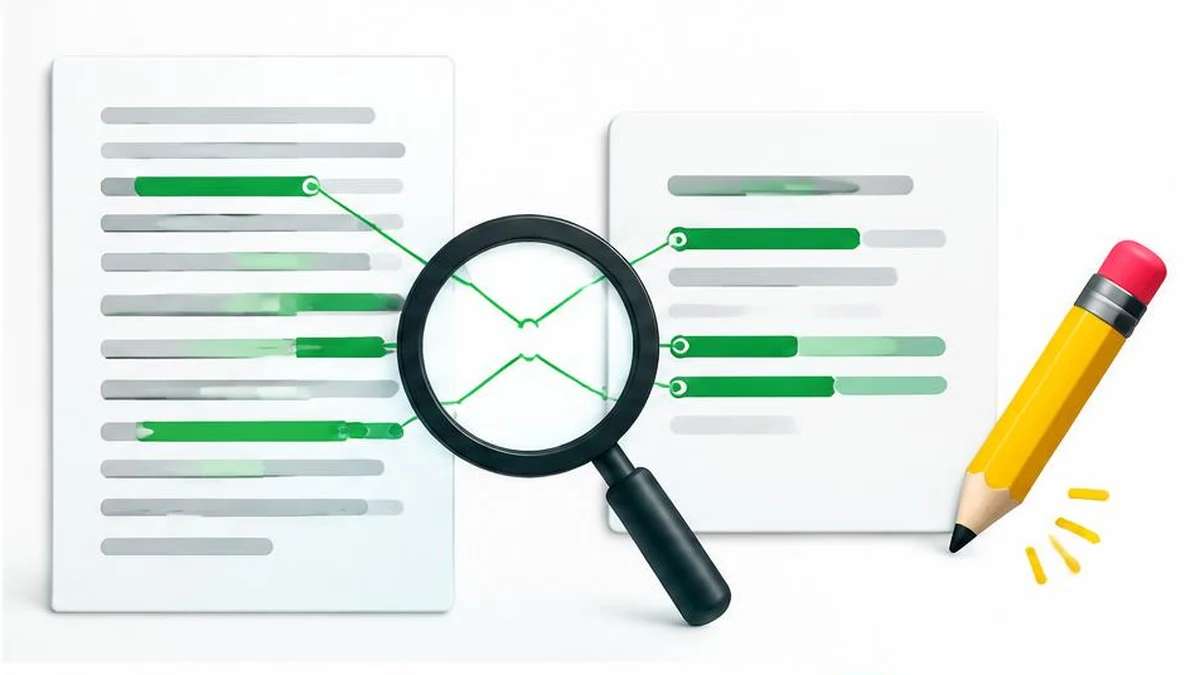
A fluent summary is a draft, not proof that the document was fully read or accurately represented. Use a claim-by-claim review against the original, verify quantities independently, and preserve uncertainty instead of passing unsupported conclusions to the next reader.
An AI summary is useful only if its important claims survive comparison with the original document. Smooth wording can conceal a missing exception, an incorrect number, or an unsupported conclusion. Before sending a summary onward, verify both what it says and what it leaves out.
Google's Gemini usage guidance warns that responses can be wrong. Its attachment guide also explains that oversized inputs can produce answers that miss connections or details. The process below turns those warnings into an editorial review you can actually perform.
Confirm that you have the complete source
Keep an unchanged copy of the original in its approved location. Record its title, version, date, and expected page count. Check whether appendices, footnotes, exhibits, and tables are part of the task. A summary of a main report is not necessarily a summary of its supplementary material.
Open the document yourself. Look for blank scans, cropped pages, rotated text, password restrictions, or broken tables. If the source uses scanned images, inspect important passages visually rather than trusting extracted text alone. A decimal point or minus sign lost during text extraction can reverse the meaning of a financial result.
Do not upload a restricted document simply to investigate whether an AI can read it. Confirm permission and use an approved workflow before sharing any source content.
Ask for a reviewable draft
Define the audience and scope before requesting the summary. A decision memo needs different coverage from a general introduction. Ask the model to distinguish source statements from interpretation and to identify the locations supporting important claims.
Useful instructions include:
- Preserve dates, units, qualifications, and the direction of any change.
- Identify exclusions and unresolved questions.
- Separate recommendations from requirements.
- Provide page or section references for decision-relevant claims.
- State uncertainty rather than filling gaps with plausible details.
These instructions make verification easier; they do not guarantee compliance or accuracy. A generated page reference is itself a claim to check against the actual document.
Build a claim-by-claim evidence table
Break the draft into individual factual assertions. A single sentence may contain an actor, a date, a number, and a condition, each requiring separate support. Start with anything that could change a decision or create a legal, financial, medical, or safety consequence.
| Claim type | Check against the source | Common failure to catch |
|---|---|---|
| Number or percentage | Exact value, units, denominator, period | A percentage change presented as percentage points |
| Deadline | Date, time zone if relevant, triggering condition | A conditional deadline presented as universal |
| Quotation | Exact wording and nearby context | A paraphrase placed in quotation marks |
| Requirement | Actor, obligation, exceptions | Advice rewritten as a mandatory rule |
| Conclusion | Supporting passage and stated uncertainty | Correlation rewritten as causation |
Record the supporting section or page and a status such as supported, needs correction, or not found. If you cannot locate support, remove the claim or mark it explicitly unresolved. Do not treat another generated answer as independent corroboration.
Recalculate numbers outside the summary
For a reported total, inspect the relevant table and notes. Check whether the figure includes tax, refunds, exclusions, or a different reporting period. Confirm whether values are in units, thousands, or millions, and whether parentheses indicate negative numbers.
Recalculate important percentages with the documented inputs. If the source does not supply enough information to reproduce a result, say so. Do not invent a denominator or silently replace a published figure with your own estimate.
When a table crosses pages, verify the headers and footnotes on both sides of the break. A model can produce a plausible sentence while associating a value with the wrong column. Selected spot checks are helpful, but they do not establish that every other number is correct.
Audit omissions, not just visible errors
Read the source sections most relevant to the reader's decision even when the summary contains no obvious mistakes. Look specifically for limitations, counterexamples, eligibility rules, exclusions, and statements of uncertainty. A technically correct sentence can still mislead if the next sentence in the source narrows it substantially.
Then review whether the summary exaggerates certainty. Replace unsupported “will” with wording that reflects the source's actual claim, not a generic hedge. Preserve distinctions such as proposed versus approved and possible versus demonstrated.
For sensitive or consequential decisions, involve a qualified human reviewer with access to the original. AI summarization should not become the sole basis for an expert judgment it cannot independently substantiate.
Compare revisions and release a checked version
Use text comparison to review edits between summary drafts and a word counter to meet a length requirement. If permitted source images need organizing into a document, image to PDF can assist that preparation. Conversion does not itself establish readable text or accurate extraction, and comparison shows differences rather than truth.
Before release, remove unsupported claims, correct citations, and label unresolved limitations. Include the source version and a review date so a later reader can distinguish an outdated summary from a current one. If missing pages or extraction failures remain material, withhold the summary rather than presenting an incomplete review as verified.
Sources and scope
Official Google guidance reviewed November 17, 2026. This is an editorial verification workflow, not a test of a specific model, a claim of error-free output, or professional advice about the document's subject.
Frequently asked questions
Does fluent writing imply an accurate summary?
No. Readability and factual support are different properties. Check important assertions against the original.
How do I verify a quoted number?
Find the original figure, inspect its units and notes, and verify its period and denominator before reproducing it.
What should I do with missing pages?
Obtain a complete source or explicitly limit the scope. Do not describe the whole document as verified when material pages are missing.
Can OCR errors affect a summary?
Yes. Compare important extracted passages with the page image, especially numbers, symbols, and table headings.
Are generated citations reliable evidence?
Not by themselves. Open the referenced source and confirm that the cited location supports the claim.
Can text comparison prove the summary is true?
No. It reveals textual differences. Factual verification requires checking the source and the meaning of the claims.
Useful on MayreDukaan
Sources
Facts last checked against these sources on 17 Nov 2026, 06:44 Pakistan time.
Images: Original AI-generated illustration by MayreDukaan; conceptual, not a product screenshot.
More trending articles
 AI and SoftwarePrepare a Spreadsheet for Safer Gemini Analysis17 Nov 2026 · 4 min read
 Shopping and DealsUK Fake Online Shops: Check the Seller Before Paying17 Nov 2026 · 5 min read
 Artificial IntelligenceGemini Activity Privacy: History, Training and Deletion17 Nov 2026 · 5 min read
 Android and SmartphonesAndroid Unknown Tracker Alerts: A Safety-First Guide17 Nov 2026 · 5 min read