UK Online vs In-Store Returns: A Retailer’s Guide
Start by asking what went wrong. A customer may simply dislike a color, may have received the wrong item, or may report a fault that appeared during use. Those are not interchangeable situations. GOV.UK distinguishes in-person change-of-mind requests from distance-sale cancellations and rights concerning faulty or misdescribed goods. This guide summarizes that official guidance, not every contractual or legal edge case. Escalate disputed facts or unusual transactions rather than forcing every request into the same shop policy.
Classify the complaint before discussing a deadline
Start by asking what went wrong. A customer may simply dislike a color, may have received the wrong item, or may report a fault that appeared during use. Those are not interchangeable situations. GOV.UK distinguishes in-person change-of-mind requests from distance-sale cancellations and rights concerning faulty or misdescribed goods. This guide summarizes that official guidance, not every contractual or legal edge case. Escalate disputed facts or unusual transactions rather than forcing every request into the same shop policy.
Identify how the contract was made
Record whether the purchase was concluded in the shop, online, by telephone or through another distance channel. Collection in person does not, by itself, tell you where the contract was made: a reservation and a completed online purchase can involve different facts. Keep the order confirmation and terms shown at checkout. If the classification is unclear, seek advice before refusing a request. Staff should not use the location of the returns desk as the only test of the customer’s rights.
Handle in-store change of mind separately
GOV.UK says sellers generally do not have to refund an in-person buyer who simply no longer wants an item, subject to the circumstances described in its guidance. Your business may offer a more generous exchange or return policy. If it does, explain and follow that policy without suggesting it limits rights for faulty goods. A sign saying “no refunds” can mislead customers about those rights. Sale goods do not lose statutory protection merely because the price was reduced.
Apply the distance-sale guidance carefully
For qualifying online, mail or telephone purchases, GOV.UK describes a period of 14 days after receipt to notify cancellation and another 14 days to return the item. Its guidance also addresses refund timing and standard delivery charges. Confirm the transaction, goods and applicable exceptions before using those periods in a customer response. Do not convert them into a universal “28-day returns” promise: notification and return are separate stages, and different facts can affect the legal analysis.
Check exceptions without overstating them
The official guidance lists examples involving personalized goods, perishables, unwrapped media and certain unsealed hygiene products. Read the exact conditions before deciding that a particular product qualifies. A change-of-mind exception does not automatically remove rights when goods are faulty or not as described. Digital content and services raise additional issues and should not be processed using a simple physical-goods checklist. Ask for specialist advice when consent requirements, mixed contracts or unusual product conditions are involved.
Build a neutral evidence record
Keep the purchase date, delivery date, customer notification, stated problem and relevant product information. Request appropriate proof of purchase rather than assuming a printed receipt is the only possible evidence; GOV.UK gives other examples. Use the date difference calculator only for arithmetic after establishing the correct rule and date. It does not determine legal entitlement. Avoid unnecessary personal data in working notes, and keep dispute evidence in your approved business systems rather than pasting it into unrelated tools.
Give staff a response they can explain
Create separate response paths for voluntary returns, distance cancellations and alleged faults. Use text compare to review changes to your staff script, and the word counter to keep the customer summary readable. Neither tool checks consumer law. State what information is missing, the next action and how the customer can contact you. Do not promise every faulty-goods case has the same immediate remedy; the remedy can depend on timing, facts and the applicable law. Review hard cases with qualified support.
Final review checklist
- Record the complaint type and how the contract was made.
- Check exceptions before quoting a cancellation period.
- Keep evidence and explain the next step without restricting rights.
Evidence and scope
Research checked on 17 November 2026. The linked primary guidance supports this workflow; illustrative scenarios are not measured market results. Recheck the current official requirements before a consequential decision. 1 2
Frequently asked questions
Do sale goods lose return rights?
No. GOV.UK says sale goods retain the same statutory rights.
Is an in-store change of mind the same as a fault?
No. They need separate assessment.
Is every online purchase cancellable?
No. Exceptions and transaction-specific conditions matter.
Is a paper receipt always essential?
No. GOV.UK recognizes other evidence of purchase.
Does collection make a sale in-store?
Not necessarily. Establish how and when the contract was concluded.
Useful on MayreDukaan
Sources
Facts last checked against these sources on 17 Nov 2026, 06:40 Pakistan time.
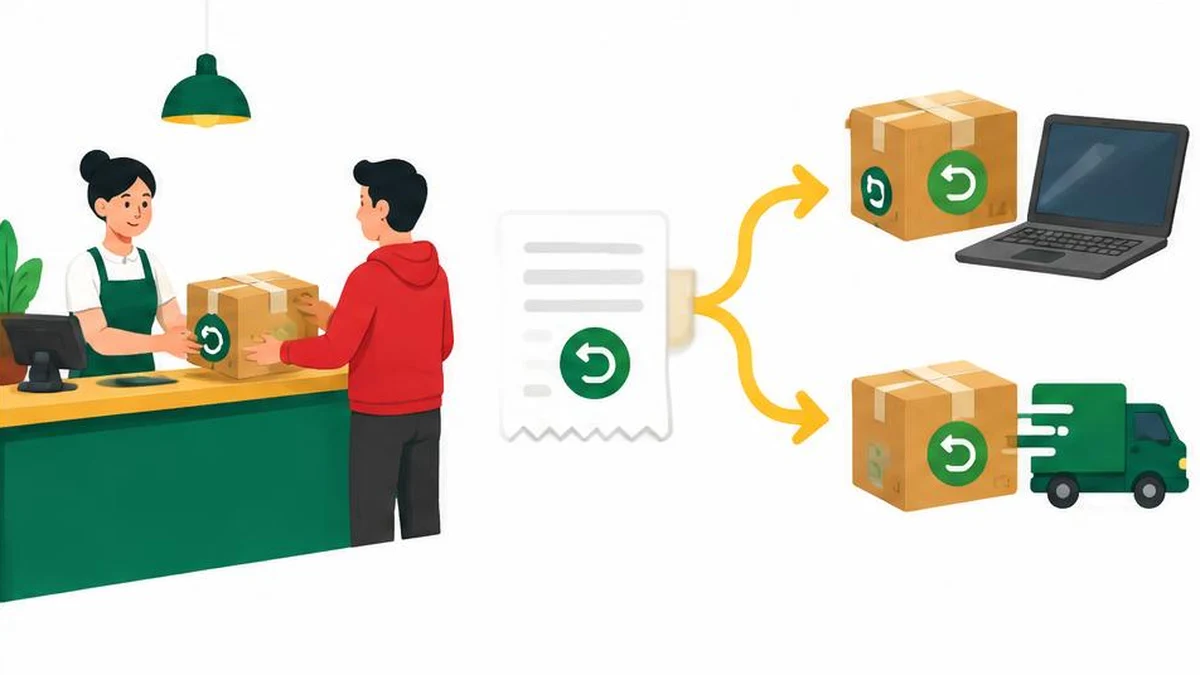
Images: Original AI-generated illustration by MayreDukaan; conceptual, not a product screenshot.
More trending articles
 Shopping and DealsUK Fake Online Shops: Check the Seller Before Paying17 Nov 2026 · 5 min read
 AI and SoftwareVerify an AI Summary Against the Original Document17 Nov 2026 · 5 min read
 Artificial IntelligenceGemini Activity Privacy: History, Training and Deletion17 Nov 2026 · 5 min read
 AI and SoftwarePrepare a Spreadsheet for Safer Gemini Analysis17 Nov 2026 · 4 min read