
Free vs freemium vs open source
By MayreDukaan Research · Researched 2026-11-17
Free, freemium and open source answer different questions. In this comparison, free means an offer with no monetary charge, not the free-software movement's meaning of user freedom. Freemium describes a pricing model with a free base offering and paid upgrades. Open source describes distribution terms that satisfy the Open Source Initiative's Open Source Definition, including access to source code and permission for modification and redistribution. [Sources: GNU software categories, Stripe and OSI.]
Because these labels describe different dimensions, they are not mutually exclusive product categories. A no-cost download can remain proprietary, while open-source software can be sold or accompanied by paid services. The practical task is to read both the price offer and the license instead of assuming that one settles the other. The table keeps those checks separate. [Sources: OSI and GNU.]
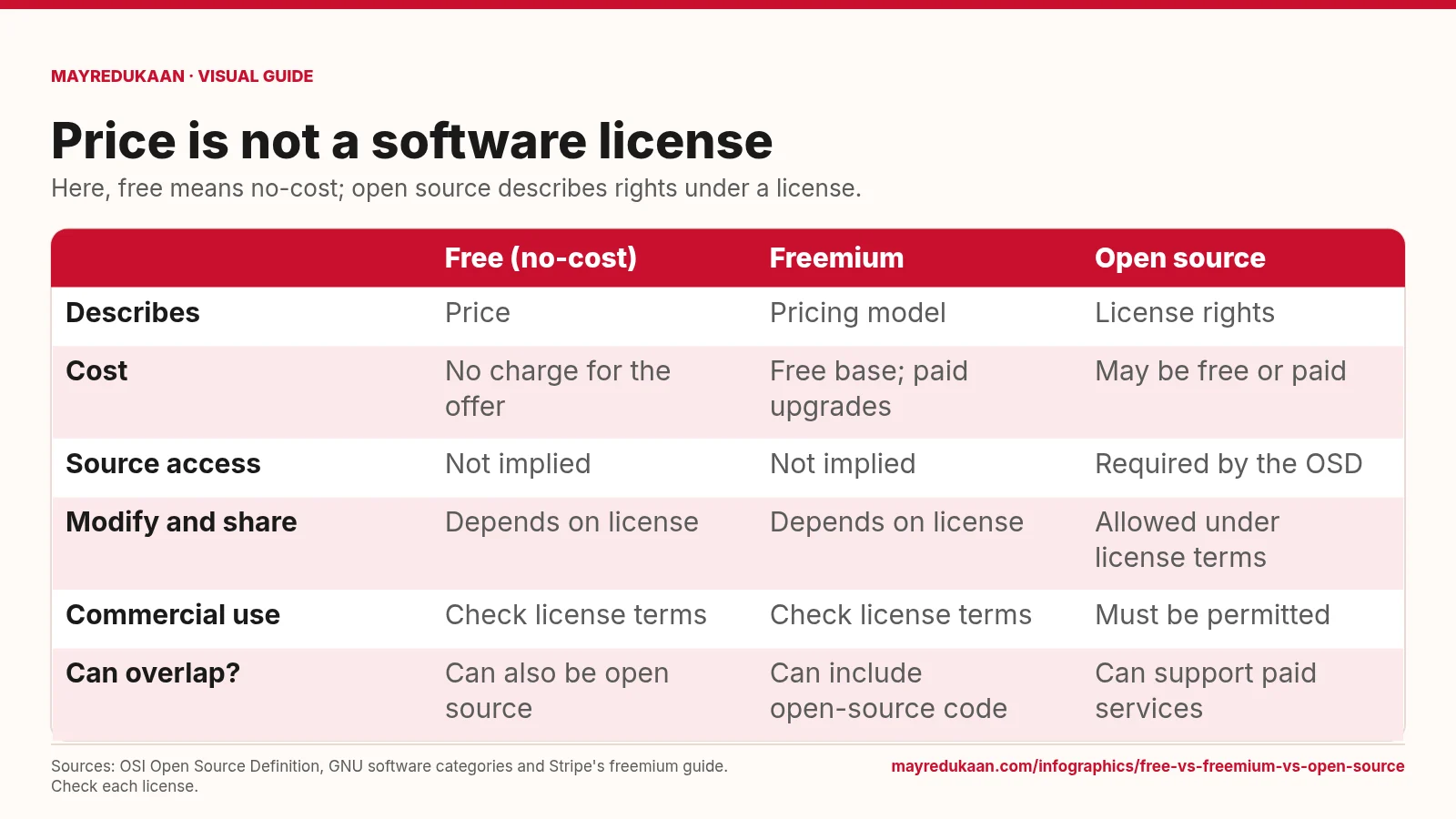
What the diagram shows
| Free (no-cost) | Freemium | Open source | |
|---|---|---|---|
| Describes | Price | Pricing model | License rights |
| Cost | No charge for the offer | Free base; paid upgrades | May be free or paid |
| Source access | Not implied | Not implied | Required by the OSD |
| Modify and share | Depends on license | Depends on license | Allowed under license terms |
| Commercial use | Check license terms | Check license terms | Must be permitted |
| Can overlap? | Can also be open source | Can include open-source code | Can support paid services |
Sources: OSI Open Source Definition, GNU software categories and Stripe's freemium guide. Check each license.
Read the two pricing columns
The first column uses free only in the everyday no-cost sense stated in the subtitle. That price says nothing by itself about whether you receive source code or permission to modify and redistribute it. GNU's software categories warn that freeware is not a precise, agreed licensing category and should not be confused with free software as a statement of freedom. The freemium column describes a different pricing arrangement: a base version is available without charge while advanced functionality or expanded access is sold. Stripe describes several ways to structure those upgrades. Neither pricing label alone establishes the legal rights granted by the software license. [Sources: GNU software categories and Stripe.]
Read the open-source rights column
The open-source column rests on the OSI definition, not just on whether a repository is visible. The definition requires source code, permits derived works and protects redistribution, subject to the applicable license terms. It also prohibits discrimination against people, groups and fields of endeavor, including business use. That is why the table marks commercial use as something that must be permitted. Different open-source licenses can impose different obligations, so permission to modify and share should not be read as permission to ignore notices or other conditions. Source availability without the required permissions is not enough to establish that software is open source. [Source: OSI Open Source Definition.]
Check overlap and obligations before adopting
The bottom row reminds readers that price, business model and licensing rights can overlap. OSI explicitly explains that open source can be used commercially and that businesses can charge for software or services built around it. A freemium service can include open-source components without making every part of the service open source; evaluate the license of the actual component or edition you plan to use. For any choice, check what the free offer includes, which upgrades cost money, where source code is available and what redistribution conditions apply. Keep the commercial offer separate from the legal permissions rather than treating a marketing label as a complete license summary. [Sources: OSI education page and Stripe.]
Key facts
- A no-cost price does not by itself grant rights to modify or redistribute software.
- Freemium combines a free base offering with paid upgrades.
- The Open Source Definition requires more than visible source code.
- An open-source license must permit derived works and redistribution under its terms.
- Open-source licenses cannot prohibit use in a business field of endeavor.
- Open-source software can be sold commercially.
Frequently asked questions
Is free software always the same as a free download?
No; in the free-software movement, free refers to user freedoms, not necessarily a zero price.
Is publicly visible source automatically open source?
No; the distribution terms must satisfy the Open Source Definition, including the required modification and redistribution permissions.
Can open-source software be used commercially?
Yes; the Open Source Definition does not allow licenses to exclude business use.
Does freemium tell me the source-code license?
No; it describes a free-and-paid pricing arrangement, so you must check the applicable license separately.
Sources
- OSI: The Open Source Definition — accessed 2026-11-17
- OSI: What is Open Source? — accessed 2026-11-17
- GNU: Categories of free and nonfree software — accessed 2026-11-17
- Stripe: How a freemium business model works — accessed 2026-11-17
More visual guides
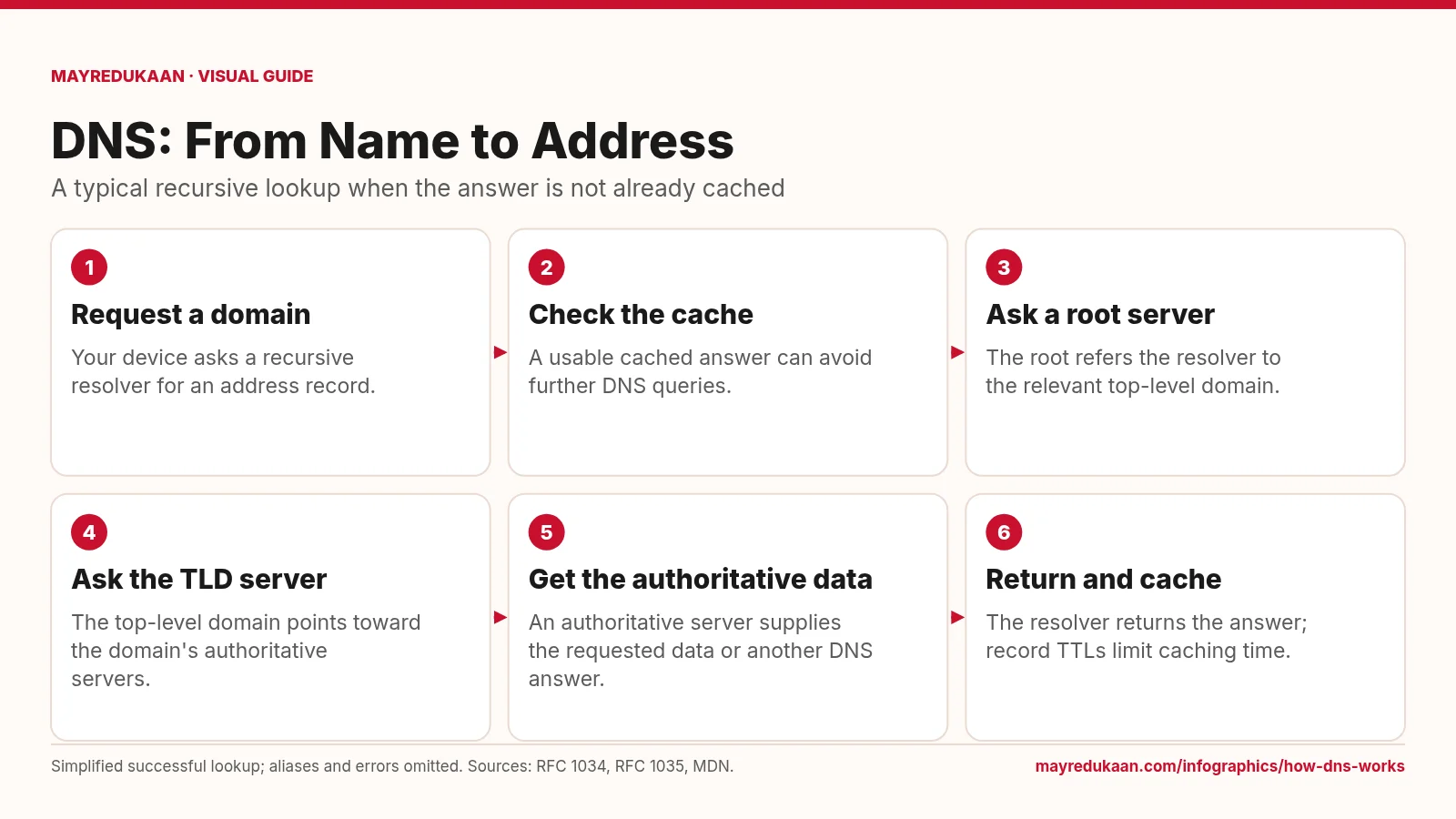
How DNS works
DNS resolves names through a distributed hierarchy, while caching can shorten the lookup.
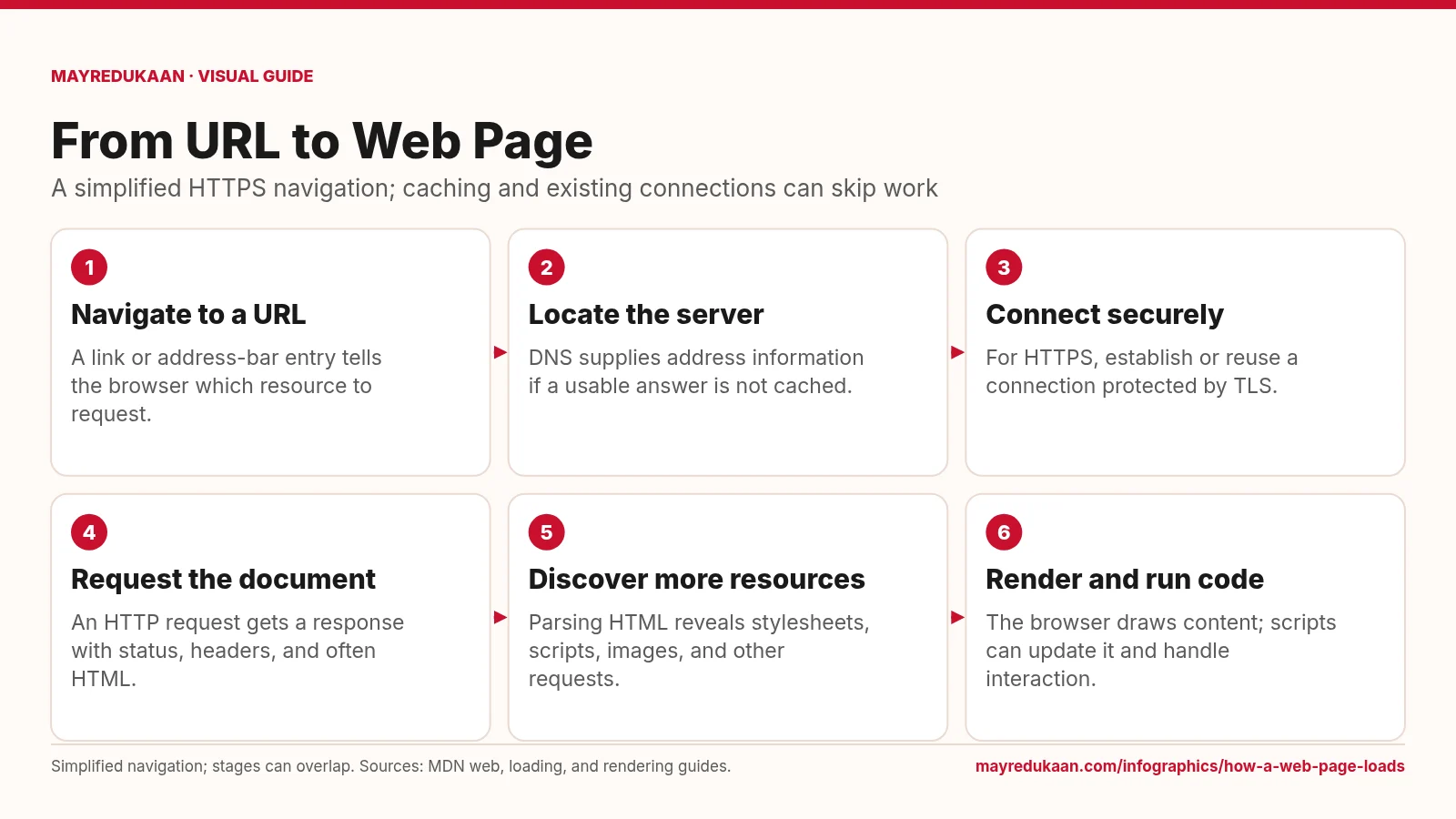
How a web page loads
Loading a page combines network requests with browser work, and those activities can overlap.
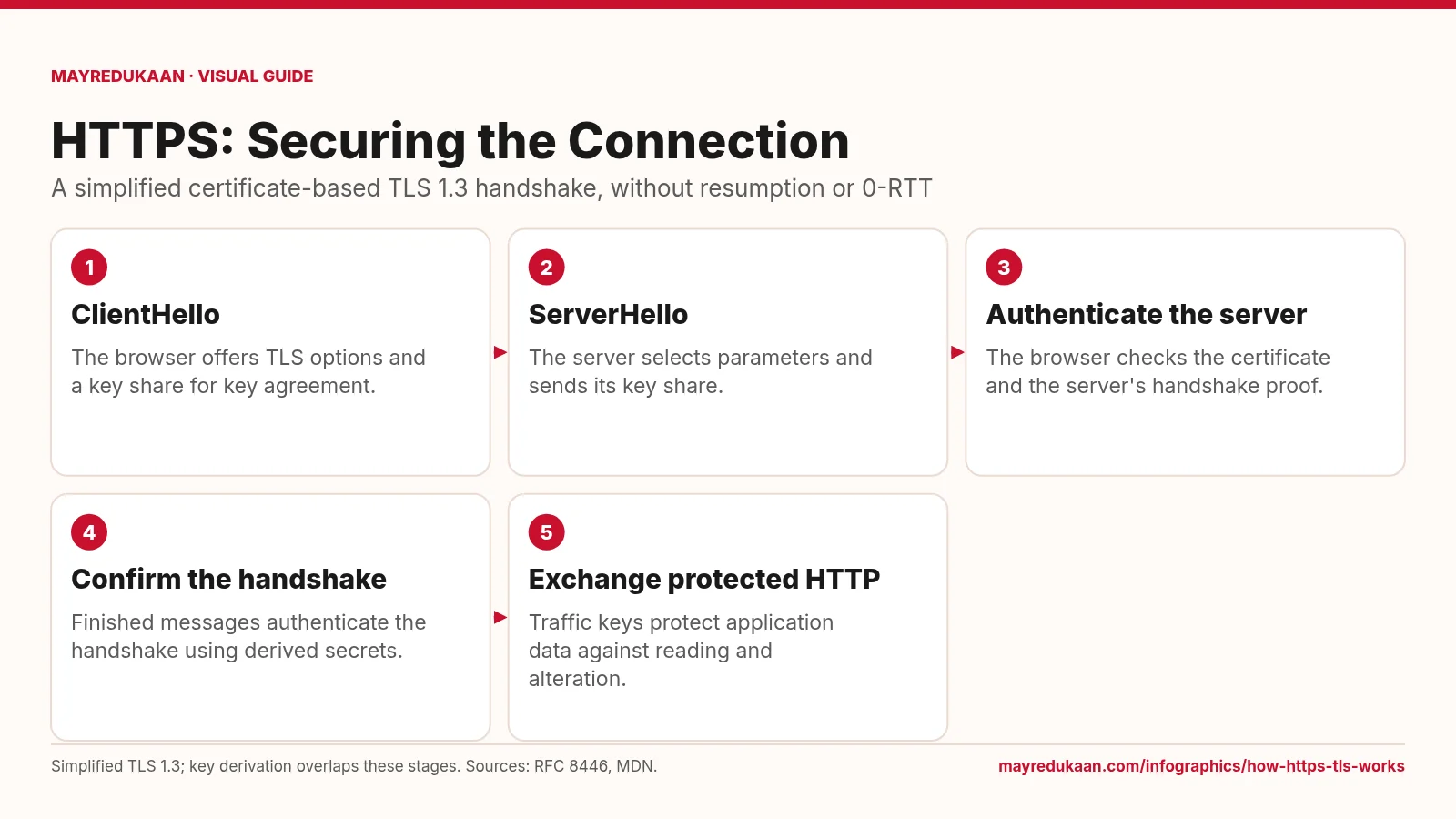
How HTTPS and TLS work
HTTPS uses TLS to authenticate the connection and protect HTTP data in transit.