
How HTTPS and TLS work
By MayreDukaan Research · Researched 2026-11-17
HTTPS is HTTP carried over a connection protected by Transport Layer Security, or TLS. It provides confidentiality and integrity for traffic between the connected endpoints, together with server authentication in the usual certificate-based web setup. A browser checks the server's credentials while the handshake establishes shared secrets. Those secrets support the traffic keys used to protect application data, rather than requiring the browser to send a reusable encryption password to the server.
The infographic shows a simplified TLS 1.3 connection using certificates and fresh key agreement. It leaves out session resumption, early data, client certificates, and retry paths so that the main exchange stays readable. A protected connection is not a judgment about the honesty of a website's content. It secures the transport relationship; it does not make every action on the site safe.
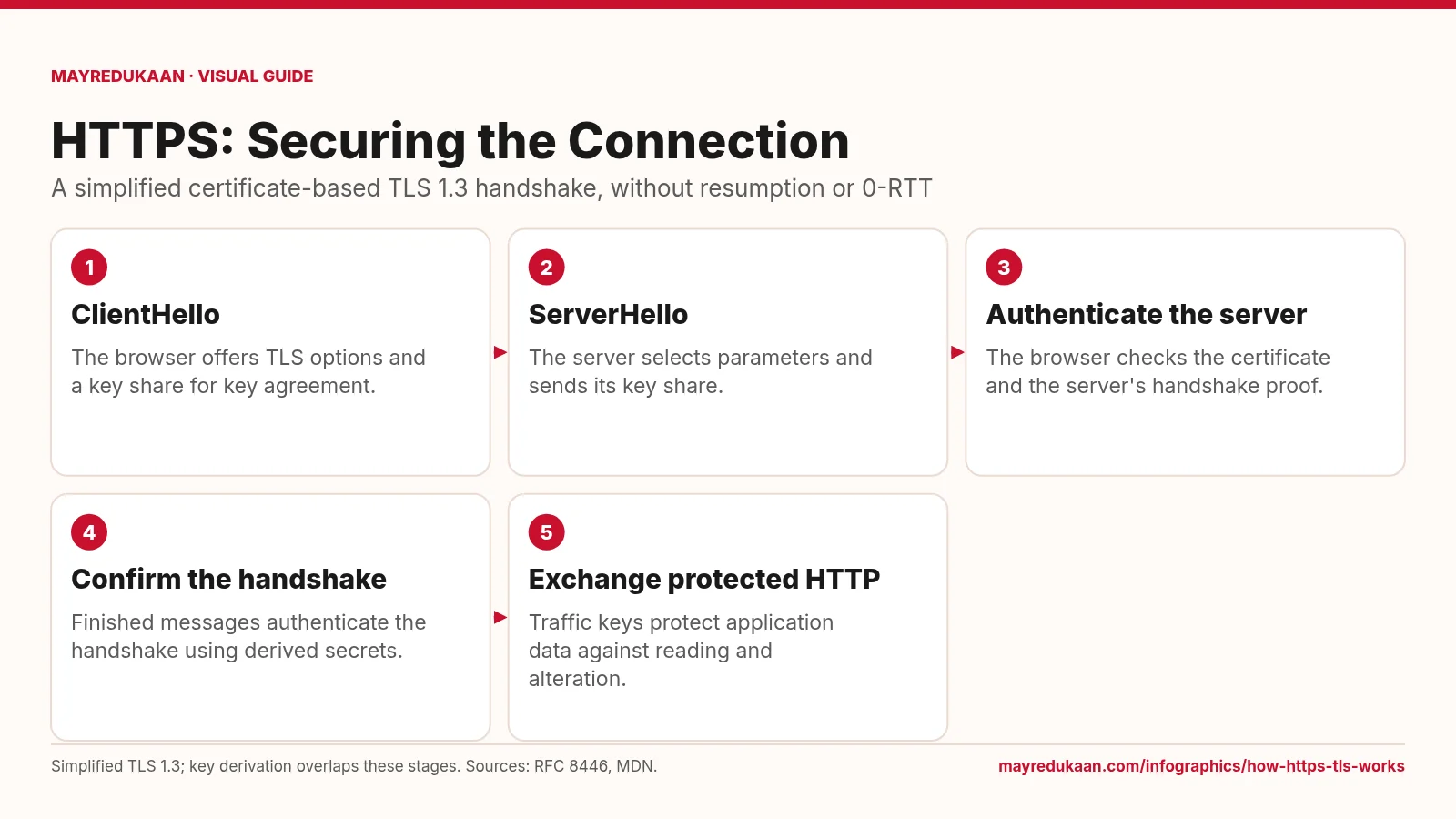
What the diagram shows
- ClientHello: The browser offers TLS options and a key share for key agreement.
- ServerHello: The server selects parameters and sends its key share.
- Authenticate the server: The browser checks the certificate and the server's handshake proof.
- Confirm the handshake: Finished messages authenticate the handshake using derived secrets.
- Exchange protected HTTP: Traffic keys protect application data against reading and alteration.
Simplified TLS 1.3; key derivation overlaps these stages. Sources: RFC 8446, MDN.
Agree on parameters and derive shared secrets
The first box is ClientHello, where the browser offers supported parameters and, in the illustrated exchange, a key share. The second box is ServerHello, where the server selects compatible parameters and provides its own key share. The parties use their key agreement and the TLS key schedule to derive secrets for protecting the exchange. These shares are not the same as transmitting a ready-made shared traffic key. In TLS 1.3, much of the remaining handshake is encrypted after ServerHello. The diagram groups related work into readable stages rather than drawing every message or every individual key-derivation operation.
Check identity and confirm the handshake
The third stage represents certificate-based server authentication. The browser evaluates the server certificate under its trust and identity checks, and the server's CertificateVerify message proves possession of the private key corresponding to its certificate. A certificate is therefore not just an encryption switch. The fourth stage represents Finished messages, which authenticate the handshake transcript using derived secrets and help detect tampering with the exchange. The illustrated flow assumes the ordinary web case where the server authenticates with a certificate. TLS also supports other arrangements, so the graphic should not be read as a complete inventory of all possible handshakes.
Protect HTTP without promising a trustworthy site
The last box shows application data, including HTTP, protected with traffic keys. TLS record protection provides confidentiality and integrity: an observer should not be able to read protected application content or alter it undetected under the protocol's security assumptions. This is protection in transit between the TLS endpoints, not a guarantee about how either endpoint handles information after receiving it. A valid HTTPS connection also does not establish that a seller is honest or that a download is harmless. Read the final arrow as a protected communication channel, not as a blanket approval of the website's behavior or business practices.
Key facts
- HTTPS uses TLS to protect HTTP communication.
- TLS 1.3 defines ClientHello and ServerHello messages for negotiating a connection.
- In certificate-based TLS 1.3 authentication, CertificateVerify proves possession of the certificate's private key.
- Finished messages authenticate the handshake transcript using derived secrets.
- TLS protects data in transit but does not guarantee that a website's content is trustworthy.
Frequently asked questions
Are HTTPS and TLS the same thing?
No; TLS is the security protocol, while HTTPS is HTTP communicated over a TLS-protected connection.
Does the browser send the server a shared encryption password?
Not in the illustrated handshake; key agreement and the TLS key schedule let both sides derive the required secrets.
Does HTTPS mean a website cannot be fraudulent?
No; transport security authenticates and protects a connection, not the truthfulness of everything the site says.
Sources
- RFC 8446: The Transport Layer Security (TLS) Protocol Version 1.3 — accessed 2026-11-17
- MDN: Transport Layer Security — accessed 2026-11-17
- MDN: HTTPS — accessed 2026-11-17
More visual guides
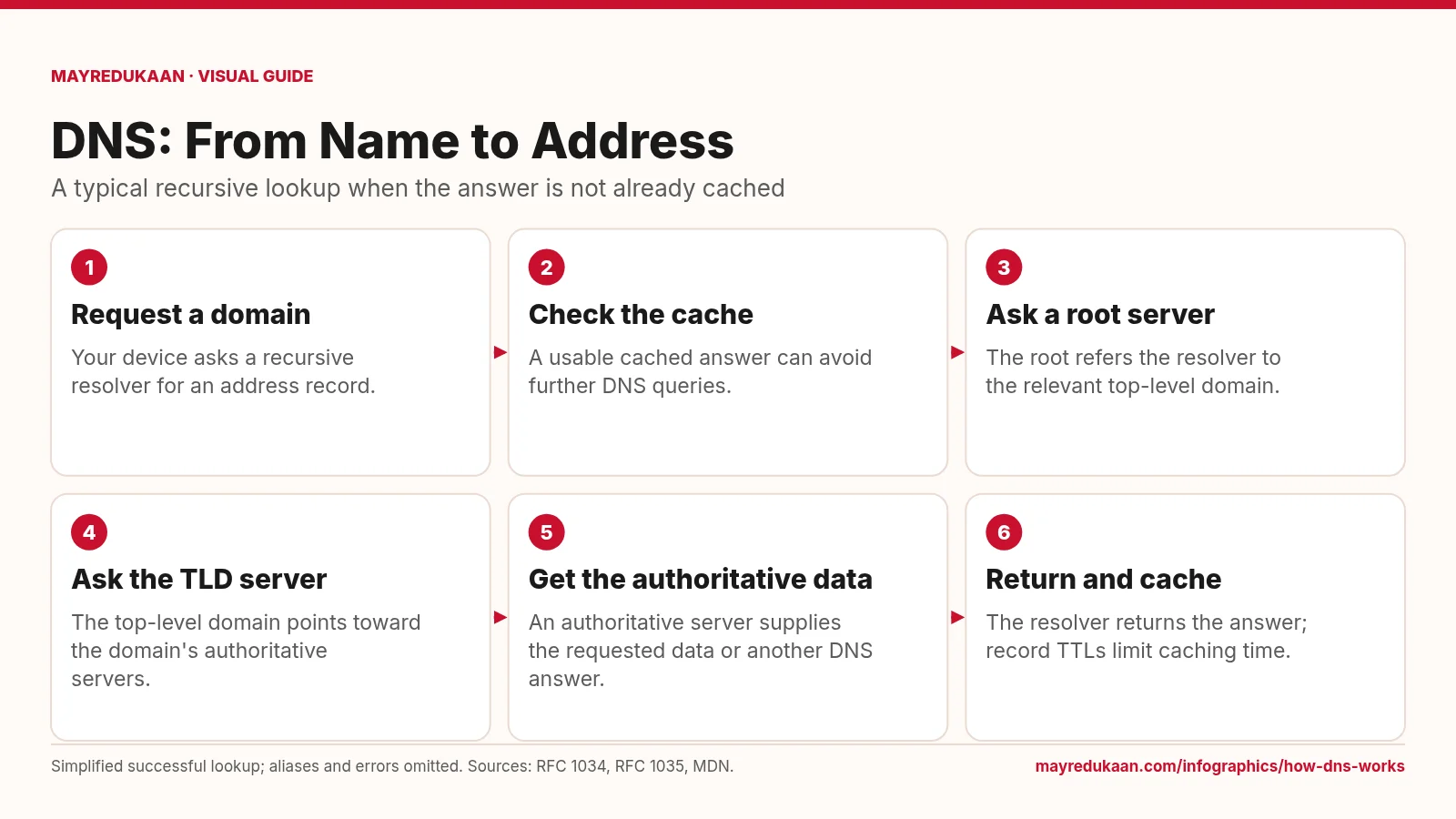
How DNS works
DNS resolves names through a distributed hierarchy, while caching can shorten the lookup.
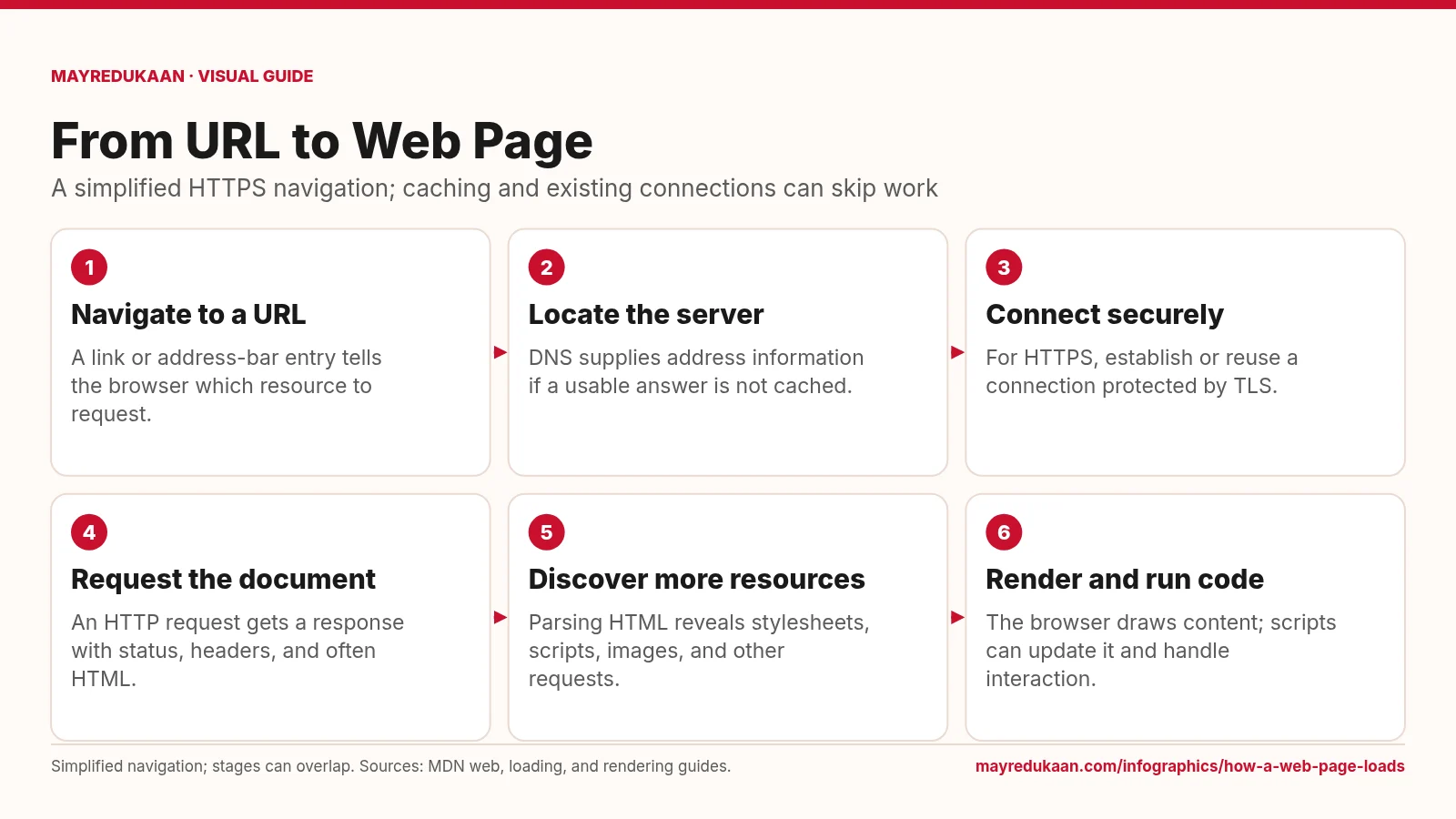
How a web page loads
Loading a page combines network requests with browser work, and those activities can overlap.
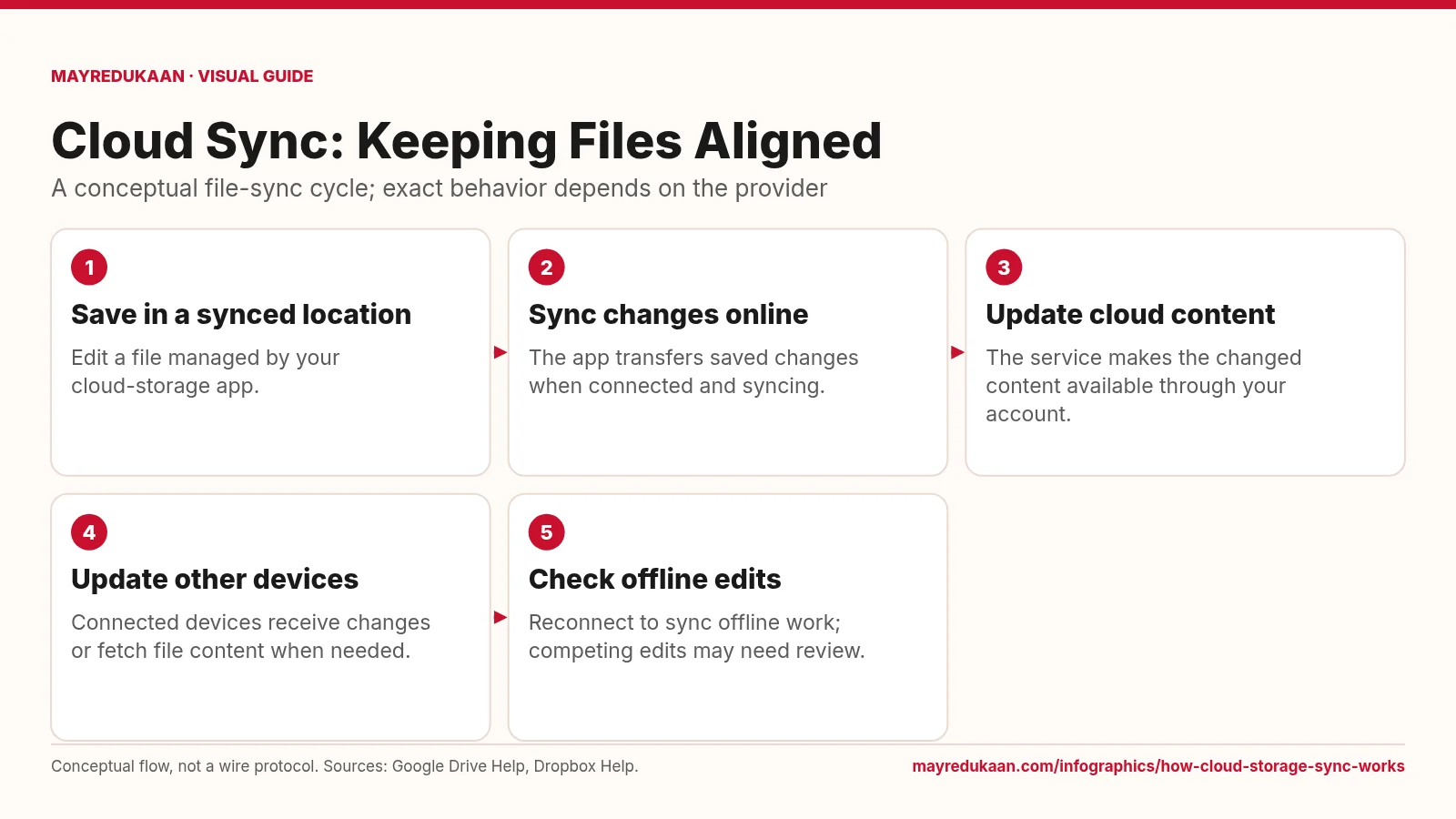
How cloud storage sync works
Synchronization carries file changes across locations, but offline availability and conflict handling vary.