
Crawling vs Indexing
By MayreDukaan Research · Researched 2026-11-17
Crawling is the process of fetching content from the web, while indexing involves analyzing that content and potentially storing information in Google's index. Googlebot can visit a page without Google ultimately indexing it. A URL can also be known through links even when Google cannot retrieve its contents. These distinctions explain why a crawl restriction is not a reliable way to remove a web page from search results.
The comparison separates the jobs, activities, controls, and obstacles involved in each stage. It also highlights a practical dependency: Google needs access to a page to discover a noindex rule placed there. Blocking that page with robots.txt can prevent the very instruction you intended Google to read. Diagnose fetching and inclusion separately instead of assuming that one setting controls both.
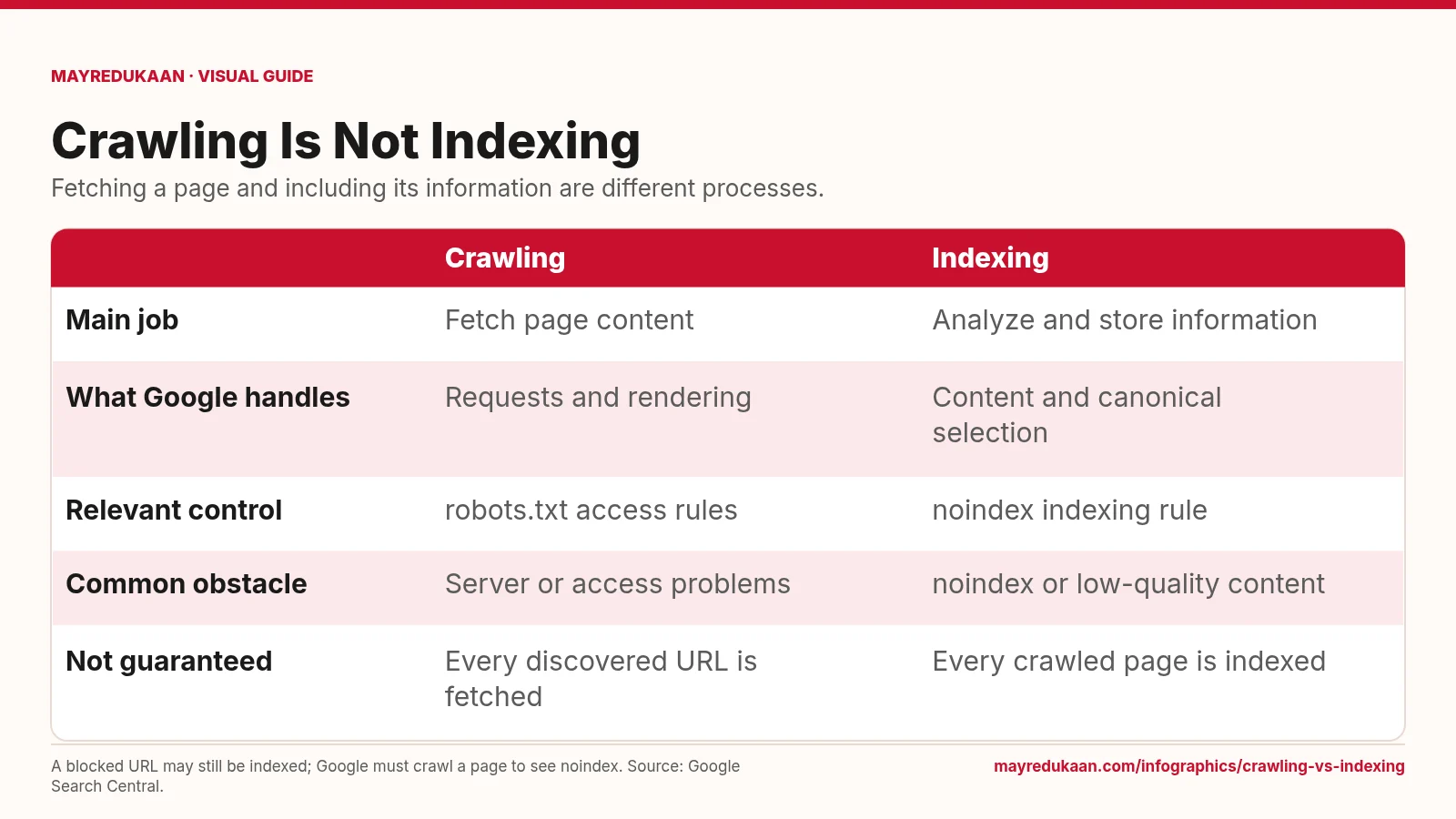
What the diagram shows
| Crawling | Indexing | |
|---|---|---|
| Main job | Fetch page content | Analyze and store information |
| What Google handles | Requests and rendering | Content and canonical selection |
| Relevant control | robots.txt access rules | noindex indexing rule |
| Common obstacle | Server or access problems | noindex or low-quality content |
| Not guaranteed | Every discovered URL is fetched | Every crawled page is indexed |
A blocked URL may still be indexed; Google must crawl a page to see noindex. Source: Google Search Central.
Compare the jobs and processing activities
The first two rows contrast the basic work. Crawling involves requesting a page and retrieving its available content; Google also renders pages to process content that may be produced by JavaScript. Indexing is the analysis that follows, including understanding content and choosing a canonical among duplicate or similar versions. Information may then be stored in the index. These stages are related but do not have identical outcomes. A successful request shows that content was accessible to a crawler, not that Google accepted it into its searchable index or will display it for a particular query.
Apply the control that matches the goal
The controls row pairs robots.txt with crawling and noindex with indexing. A robots.txt rule tells compliant crawlers which URLs they may request, but it does not reliably prevent a web page's URL from appearing in Google Search. Google can learn of a blocked URL from other pages. By contrast, a noindex rule tells Google not to include the page in search results after it retrieves and processes the rule. That dependency matters: if robots.txt blocks access, Google cannot see the page's noindex instruction. For confidential material, Google's documentation points to access protection rather than relying on crawler instructions.
Interpret obstacles and missing guarantees
The final rows identify different failure points and limits. Server errors or access problems can obstruct crawling before Google can process the page. Indexing can fail for other reasons, including a noindex rule or content quality issues. The comparison deliberately avoids equating a discovered URL with a completed fetch or a completed fetch with successful indexing. Neither progression is guaranteed. If a page is accessible but absent from the index, repeatedly changing crawl settings may not address the cause. Review the applicable indexing rule and the content itself, while remembering that Google does not guarantee indexing even when a page follows its guidance.
Key facts
- Crawling and indexing are separate stages of Google Search.
- Googlebot does not crawl every URL Google discovers.
- A robots.txt restriction does not reliably prevent a web page URL from appearing in Search.
- Google must be able to crawl a page to read a noindex rule on it.
- Successful crawling does not guarantee indexing.
Frequently asked questions
Can a page be crawled but not indexed?
Yes; Google may process a page without indexing it, including when noindex applies or content quality is insufficient.
Should I combine robots.txt blocking with noindex?
Do not block crawling of a page when you need Google to read its noindex rule, because the block prevents access to that rule.
Is robots.txt suitable for protecting private information?
No; use access protection such as password protection rather than treating robots.txt as a security mechanism.
Related free tools
Sources
- In-depth guide to how Google Search works — accessed 2026-11-17
- Introduction to robots.txt — accessed 2026-11-17
- Block Search indexing with noindex — accessed 2026-11-17
More visual guides
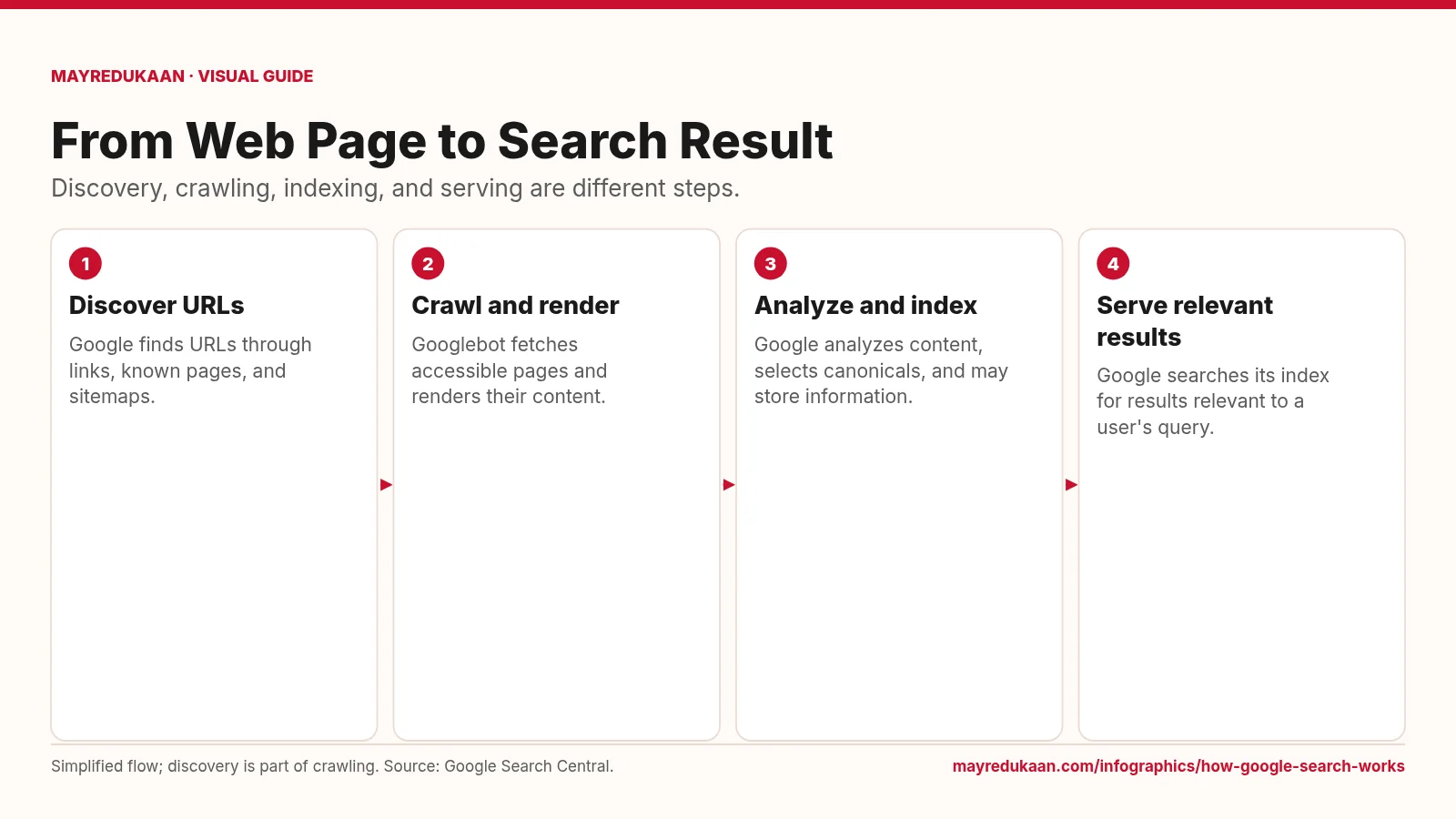
How Google Search Works
A page must be discovered and processed before its information can compete to appear for a search.
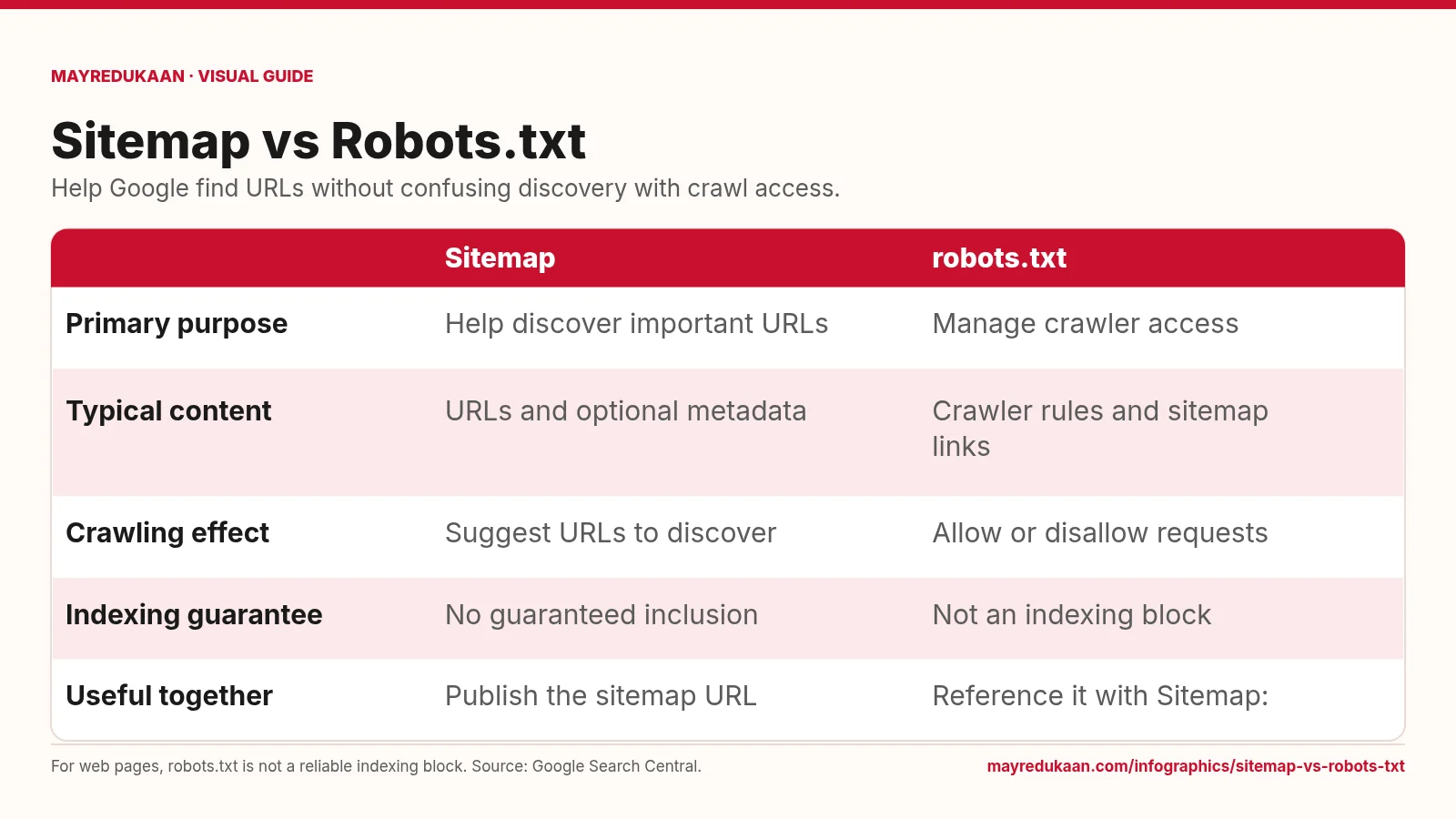
Sitemap vs Robots.txt
Sitemaps support URL discovery, while robots.txt sets crawl-access rules for compliant crawlers.
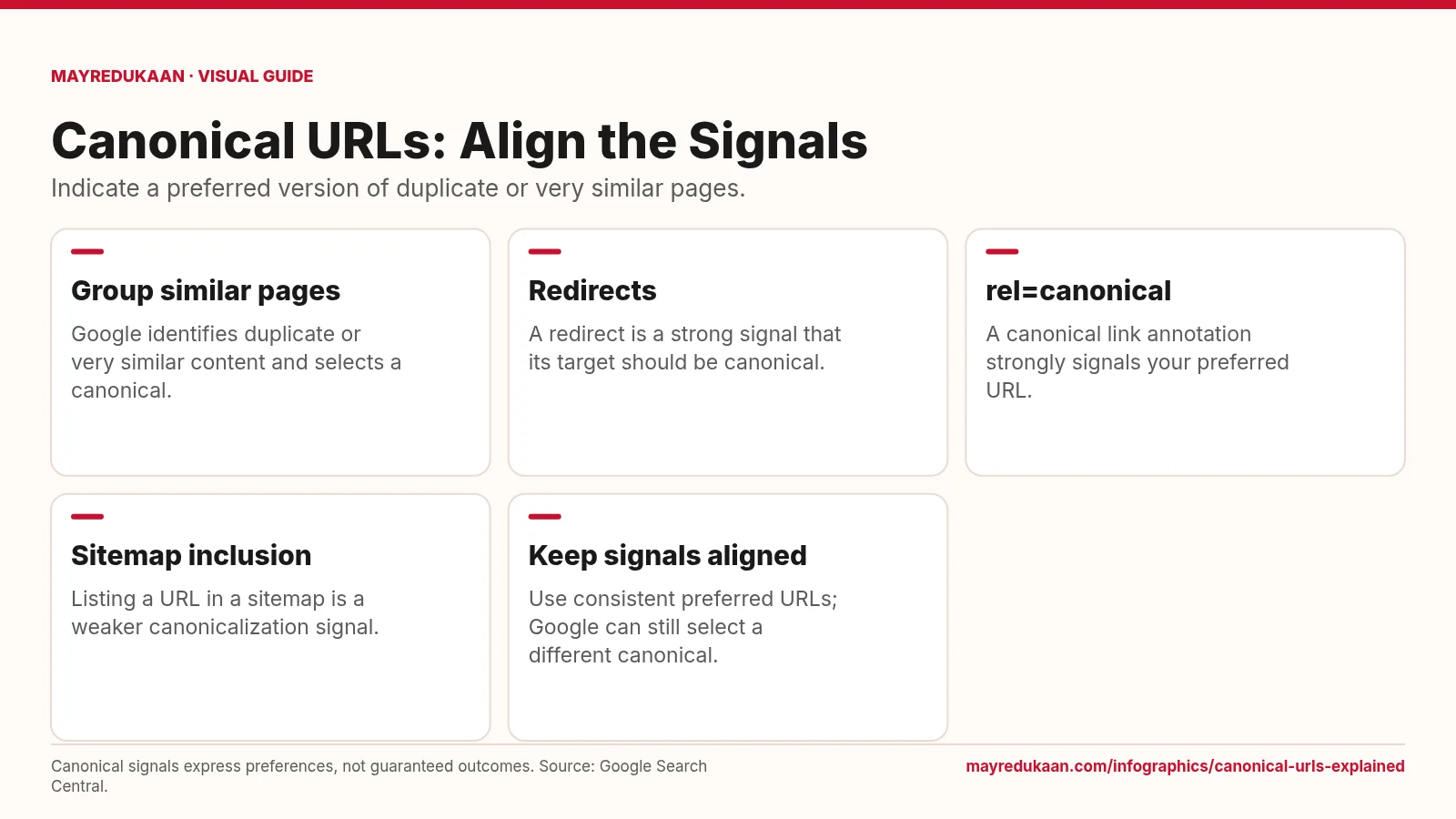
Canonical URLs Explained
Canonicalization helps Google choose a representative URL from duplicate or very similar pages.