
Canonical URLs Explained
By MayreDukaan Research · Researched 2026-11-17
A canonical URL is the address Google selects as representative of a set of duplicate or very similar pages. Different addresses can lead to essentially the same content, so Google groups those versions and chooses a canonical during indexing. Site owners can communicate a preference, but Google's selection is not guaranteed to match a declared canonical.
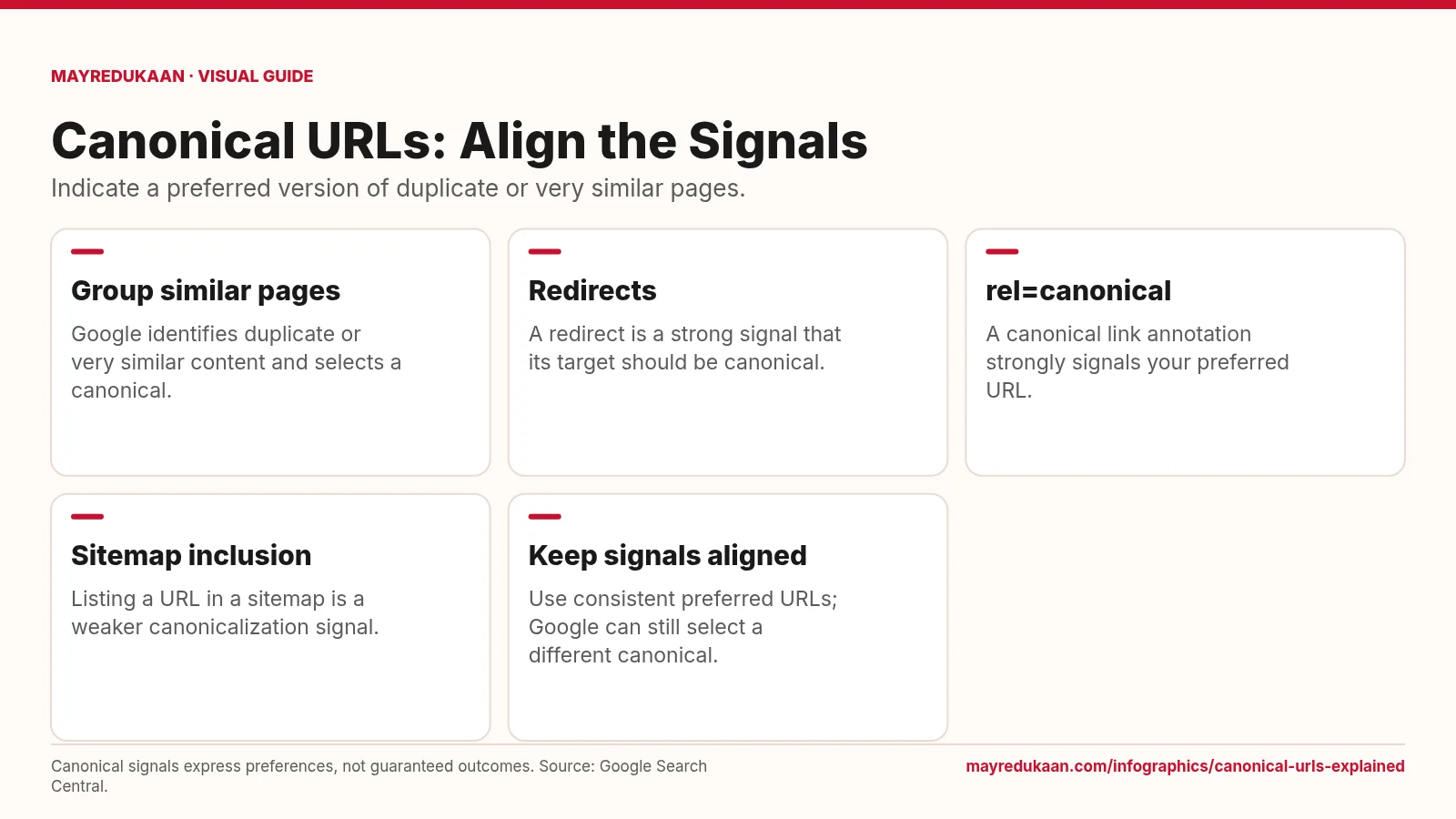
The diagram shows how that preference can be expressed through redirects, canonical link annotations, and sitemap inclusion. Google describes redirects and rel=canonical annotations as strong signals, while sitemap inclusion is weaker. These signals can reinforce one another when they agree. Canonicalization is therefore about making a coherent preference clear, not adding a command that forces Google to index a particular URL or removes the need for useful content.
What the diagram shows
- Group similar pages: Google identifies duplicate or very similar content and selects a canonical.
- Redirects: A redirect is a strong signal that its target should be canonical.
- rel=canonical: A canonical link annotation strongly signals your preferred URL.
- Sitemap inclusion: Listing a URL in a sitemap is a weaker canonicalization signal.
- Keep signals aligned: Use consistent preferred URLs; Google can still select a different canonical.
Canonical signals express preferences, not guaranteed outcomes. Source: Google Search Central.
Start with duplicate or very similar content
The first card establishes the scope: canonicalization concerns pages with duplicate or very similar content. During indexing, Google groups similar versions and chooses a representative canonical page. That is different from naming an arbitrary unrelated page as the preferred address. Google can choose a canonical automatically even when a site owner has not declared a preference. The goal of an explicit preference is to make the intended representative clearer. A canonical is not a promise of inclusion or a permanent ranking position; it is part of how Google interprets and organizes versions of content it discovers.
Understand strong and weak signals
The middle cards compare the methods Google documents. A redirect strongly signals that its destination should become canonical, while a rel=canonical link annotation strongly signals the preferred URL without being the same thing as redirecting a visitor. Including a URL in a sitemap is a weaker signal. These methods can be combined, and consistent combinations can increase the chance of Google using the preferred canonical. The cards describe relative signal strength rather than a guaranteed selection rule. Google evaluates canonicalization using its own processing, and a declared preference can differ from the URL it ultimately selects.
Keep the preference consistent across methods
The final card emphasizes alignment. Avoid sending Google one preferred URL in a canonical annotation and a different preferred URL through another canonicalization method. Google also recommends linking internally to the canonical version and using canonical URLs in a sitemap. The aim is a consistent set of clues rather than competing instructions. Do not use robots.txt as a canonicalization mechanism, and do not use noindex simply to influence canonical selection within a site. Those controls have different purposes. Review the selected canonical separately from the preference you declared, because Google's choice can remain different even when your implementation is intentional.
Key facts
- Google selects a canonical from a group of duplicate or very similar pages.
- Redirects are strong canonicalization signals.
- A rel=canonical annotation is a strong signal rather than a guaranteed directive.
- Sitemap inclusion is a weaker canonicalization signal.
- Google can choose a different canonical from the one a site owner prefers.
Frequently asked questions
Is a canonical annotation the same as a redirect?
No; a redirect sends requests to a destination, while a canonical annotation identifies a preferred URL without itself redirecting visitors.
Must I specify a canonical for Google to choose one?
No; Google can identify and select a canonical even when you do not declare a preference.
Should I use robots.txt to force a canonical?
No; Google advises against using robots.txt for canonicalization because it controls crawling rather than selecting the representative URL.
Related free tools
Sources
- How to specify a canonical URL — accessed 2026-11-17
- What is URL canonicalization? — accessed 2026-11-17
- In-depth guide to how Google Search works — accessed 2026-11-17
More visual guides
How Google Search Works
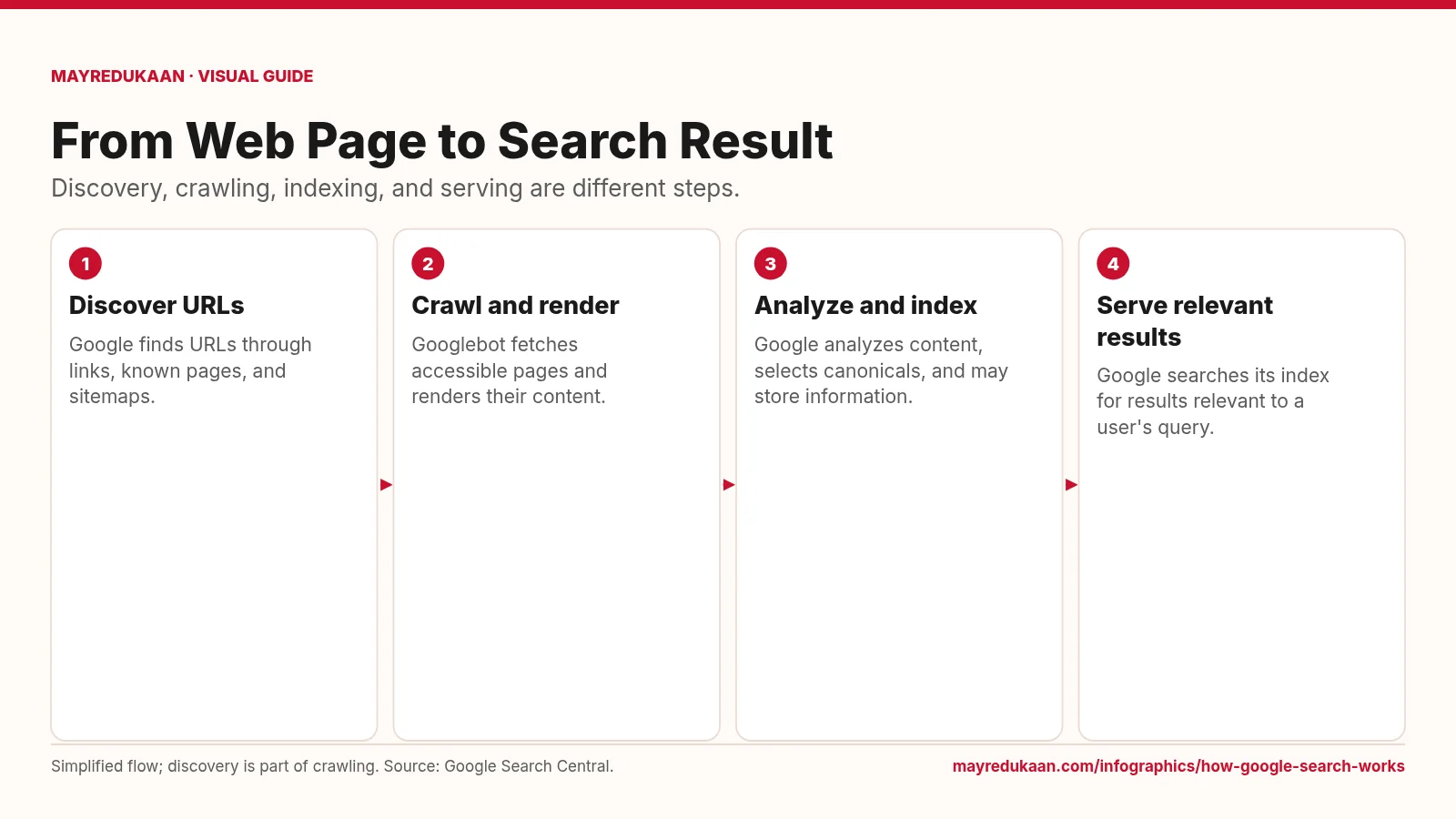
A page must be discovered and processed before its information can compete to appear for a search.
Crawling vs Indexing
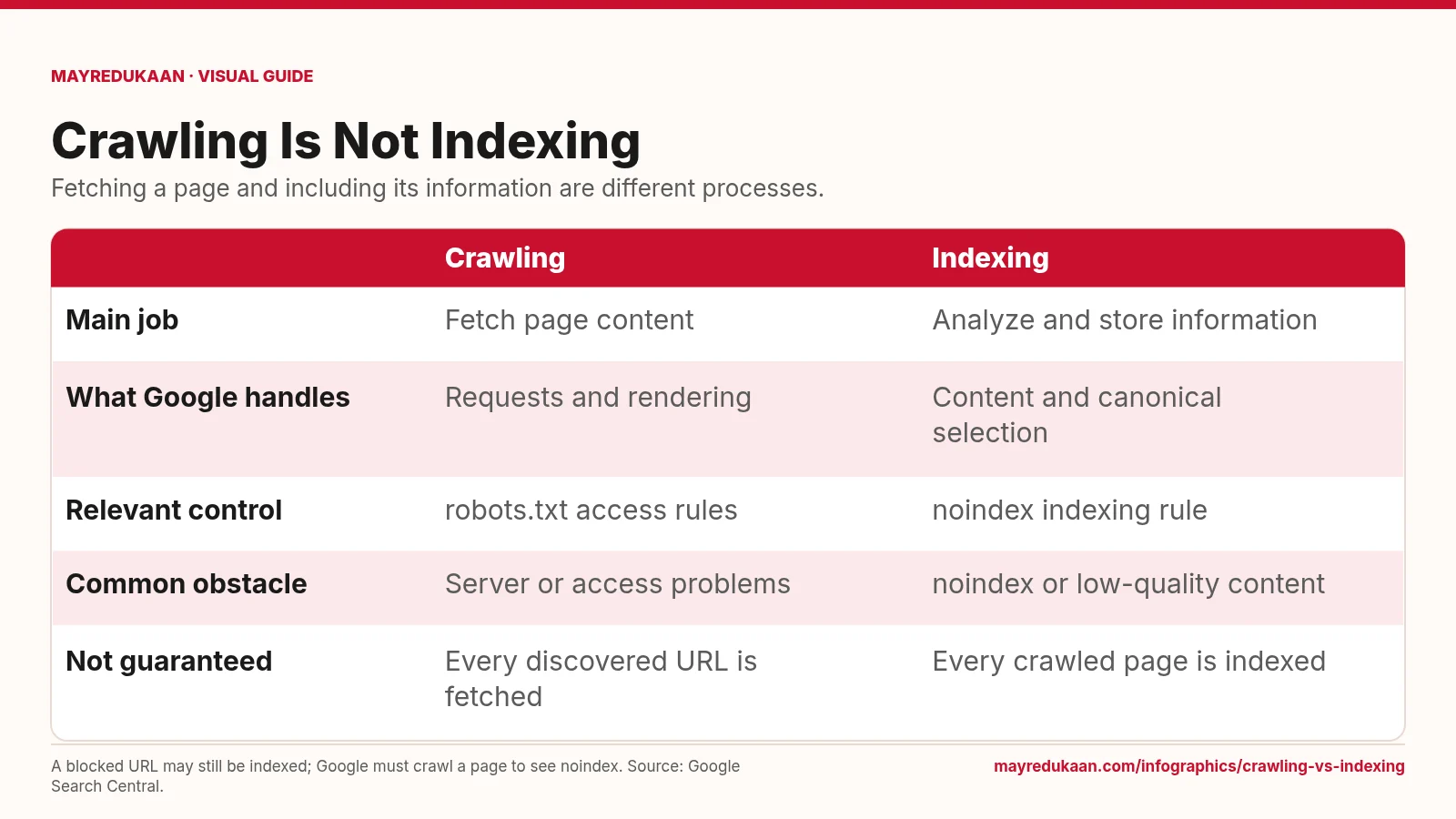
Use crawl controls for fetching and indexing rules for whether content belongs in Search.
Sitemap vs Robots.txt
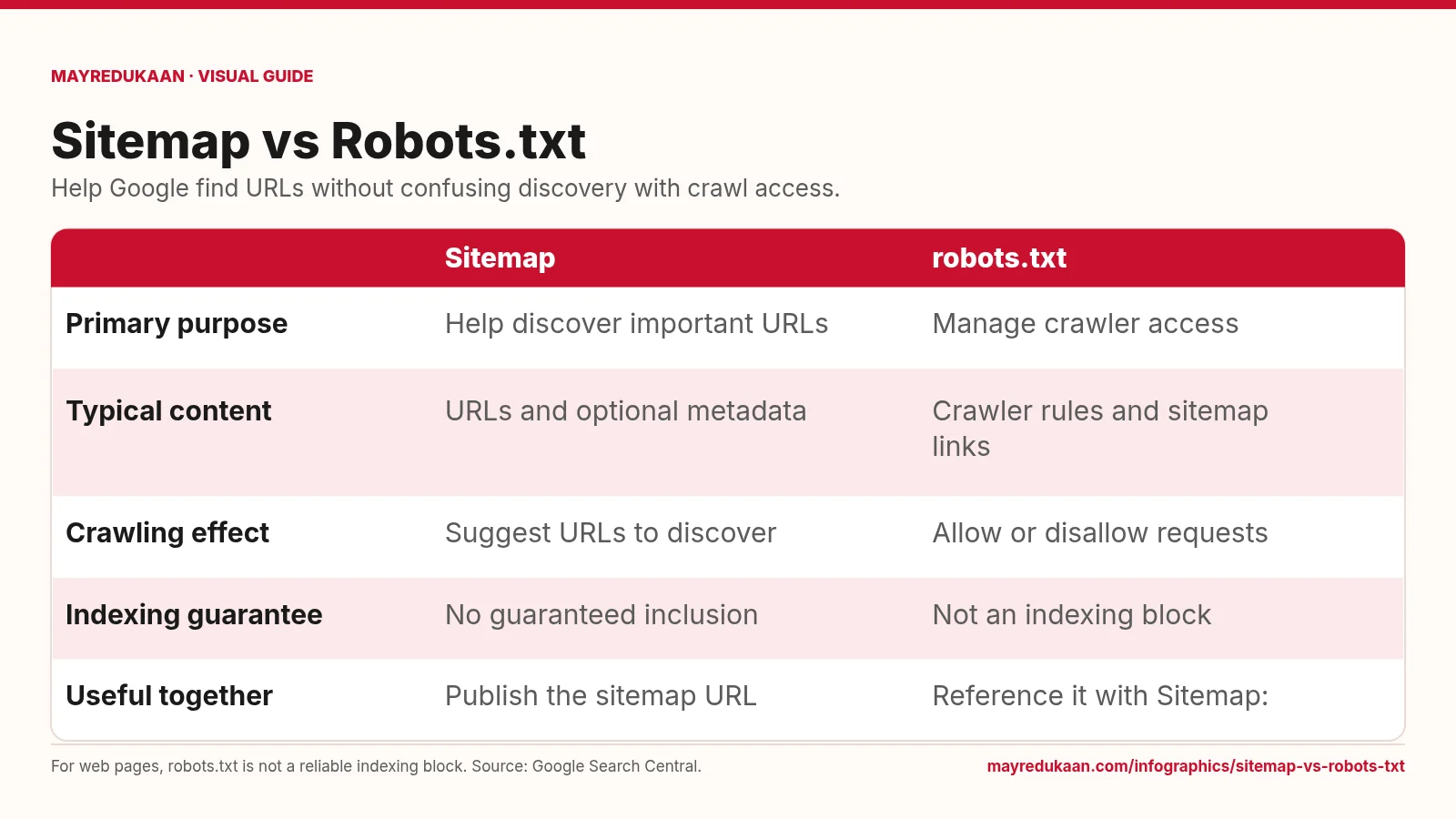
Sitemaps support URL discovery, while robots.txt sets crawl-access rules for compliant crawlers.