
How Google Search Works
By MayreDukaan Research · Researched 2026-11-17
Google Search is an automated system that discovers web pages, processes their content, and returns information relevant to a search. Google describes three main stages: crawling, indexing, and serving search results. The diagram separates URL discovery from the rest of crawling to make the sequence easier to follow. These are different activities, not interchangeable names for appearing on Google.
A discovered address might never be crawled, and a crawled page might never be indexed. Even an indexed page is not guaranteed to appear for a particular query. Understanding those distinctions helps you diagnose the right problem: access restrictions affect fetching, indexing rules affect inclusion, and relevance affects which indexed information Google serves to a user. Following Google's guidance does not guarantee passage through every stage.
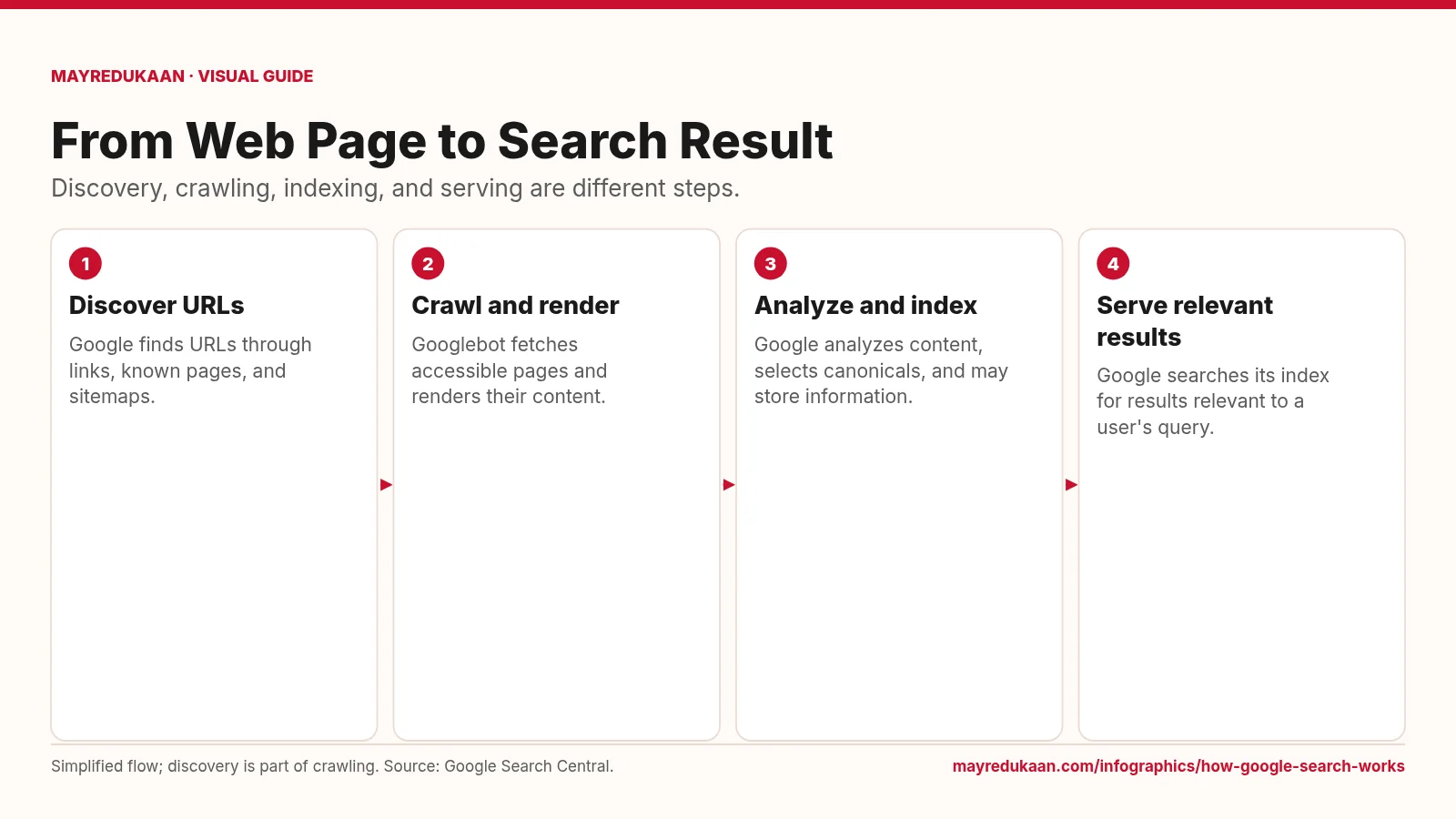
What the diagram shows
- Discover URLs: Google finds URLs through links, known pages, and sitemaps.
- Crawl and render: Googlebot fetches accessible pages and renders their content.
- Analyze and index: Google analyzes content, selects canonicals, and may store information.
- Serve relevant results: Google searches its index for results relevant to a user's query.
Simplified flow; discovery is part of crawling. Source: Google Search Central.
Discovery leads to crawling, not guaranteed inclusion
The first box represents URL discovery, which Google treats as part of crawling rather than a separate main stage. Google learns about addresses through links from pages it already knows, previously visited pages, and sitemaps. The second box shows what can happen next: Googlebot requests an accessible page and Google renders it, including running JavaScript to understand content that depends on it. Discovery does not mean the fetch will happen. A server problem, a login requirement, or a robots.txt restriction can prevent access. The diagram's first arrow therefore describes a possible progression, not a promise that every known URL advances.
Indexing means analyzing and selecting
The third box combines several indexing activities. Google examines text, images, video, and relevant page information to understand what a page is about. It also groups duplicate or very similar pages and chooses a canonical version that is representative of that group. Information about the canonical page and related versions may then be stored in Google's index. This is more than saving a copy of every fetched address. Google explicitly says that indexing is not guaranteed, and issues such as low-quality content or a noindex rule can stop a processed page from being included.
Serving depends on the search being made
The final box begins when someone submits a query. Google searches its index for matching pages and returns results it considers relevant and useful for that search. Factors such as the user's location, language, and device can affect relevance, so two searches need not produce identical results. Being indexed is therefore different from being displayed prominently or appearing for every phrase. The flow ends at serving, but it does not imply a permanent position in results. Google also states that it does not accept payment to crawl a site more frequently or to rank it higher.
Key facts
- Google describes crawling, indexing, and serving as the three main stages of Search.
- Google can discover URLs through links and sitemaps.
- Google renders pages during crawling to process content that can depend on JavaScript.
- Not every page Google crawls will be indexed.
- Google does not accept payment for higher organic rankings.
Frequently asked questions
Does submitting a sitemap guarantee a place in Search?
No; a sitemap helps Google discover URLs but does not guarantee crawling or indexing.
Why can an indexed page fail to appear for my search?
Indexing does not guarantee display for a query; relevance, quality, and other serving considerations affect results.
Does Google need every page to be submitted manually?
No; Google finds most pages in its results automatically through its crawlers.
Related free tools
Sources
- In-depth guide to how Google Search works — accessed 2026-11-17
- SEO Starter Guide — accessed 2026-11-17
- Learn about sitemaps — accessed 2026-11-17
More visual guides
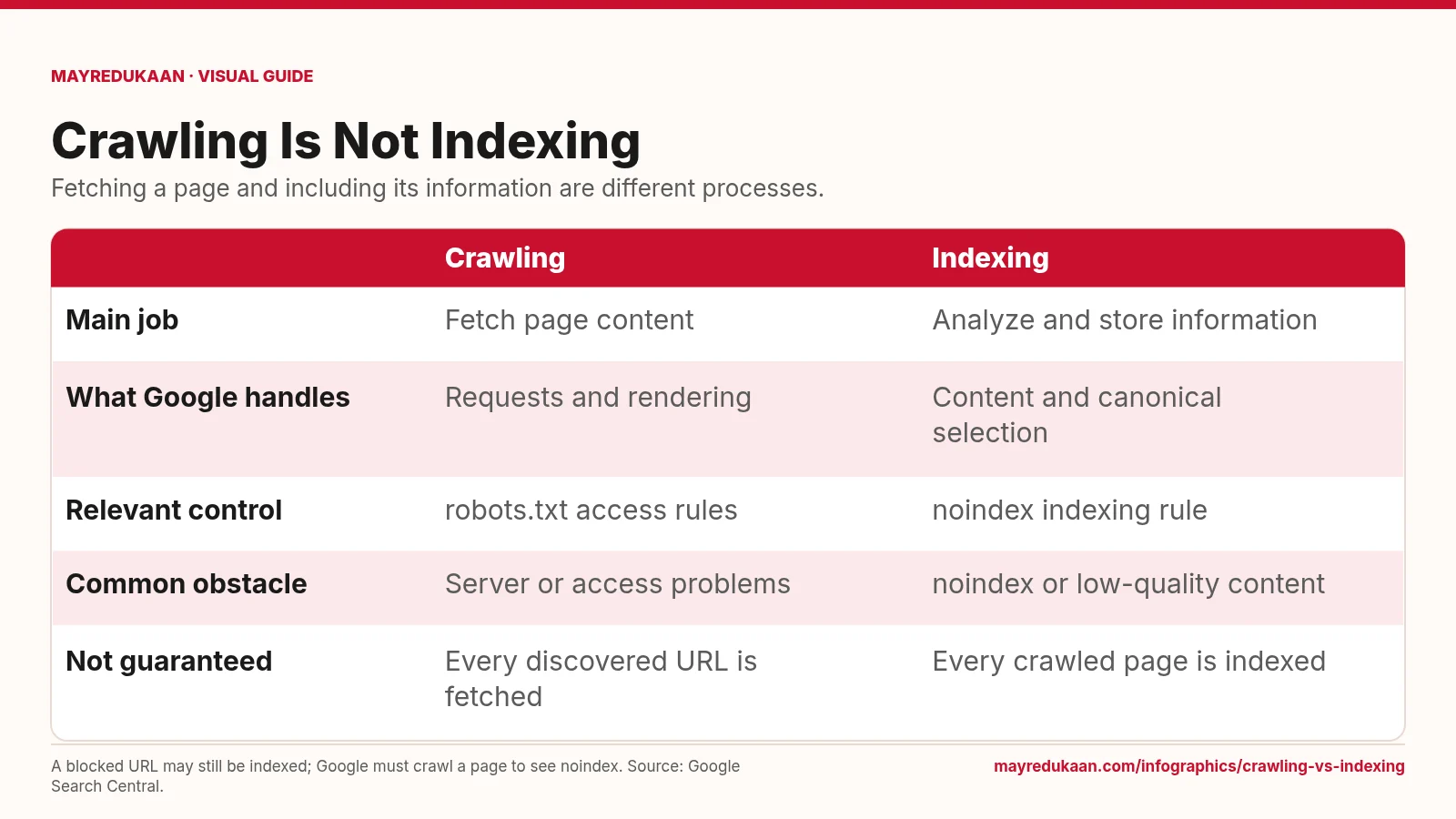
Crawling vs Indexing
Use crawl controls for fetching and indexing rules for whether content belongs in Search.
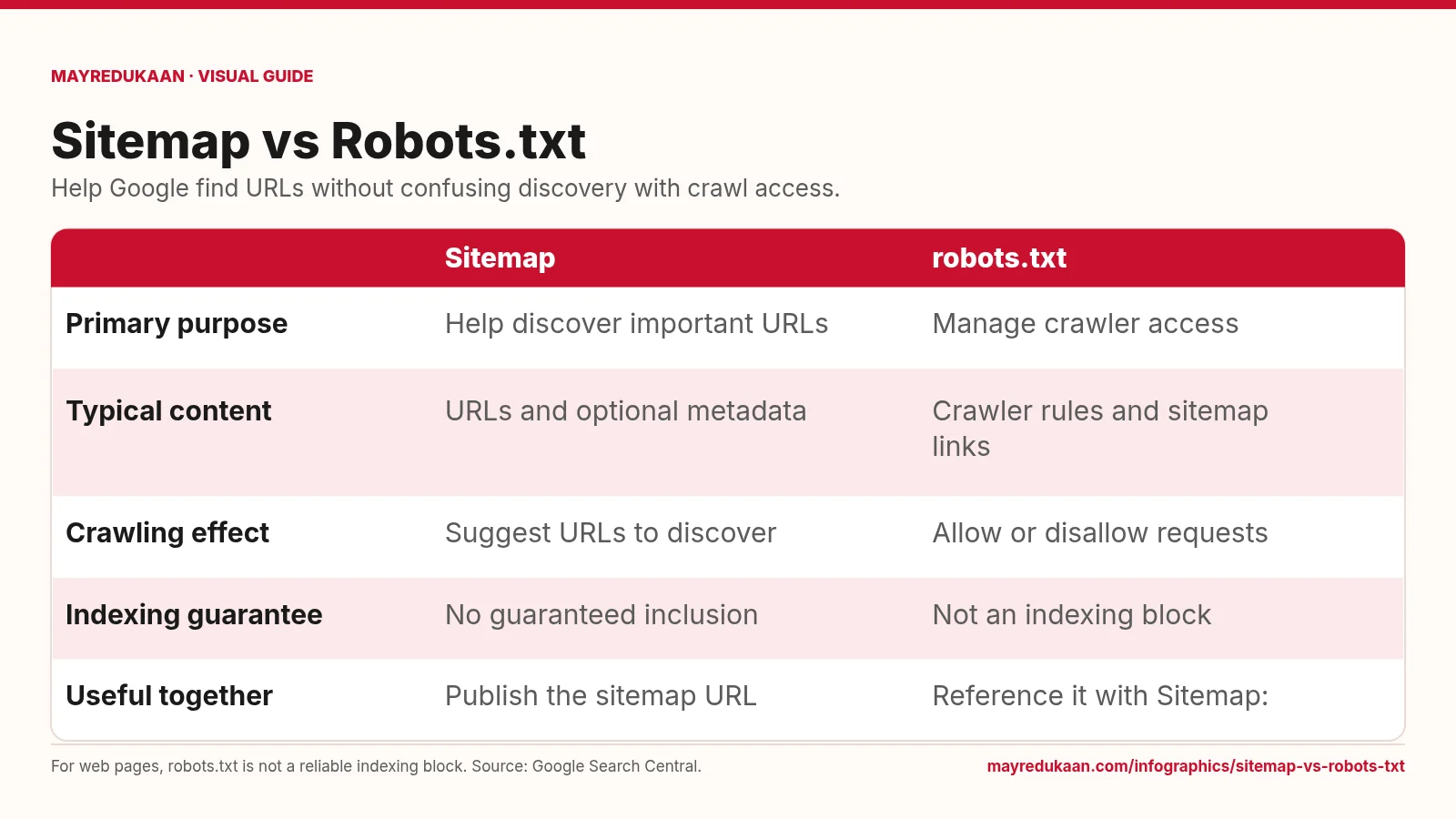
Sitemap vs Robots.txt
Sitemaps support URL discovery, while robots.txt sets crawl-access rules for compliant crawlers.
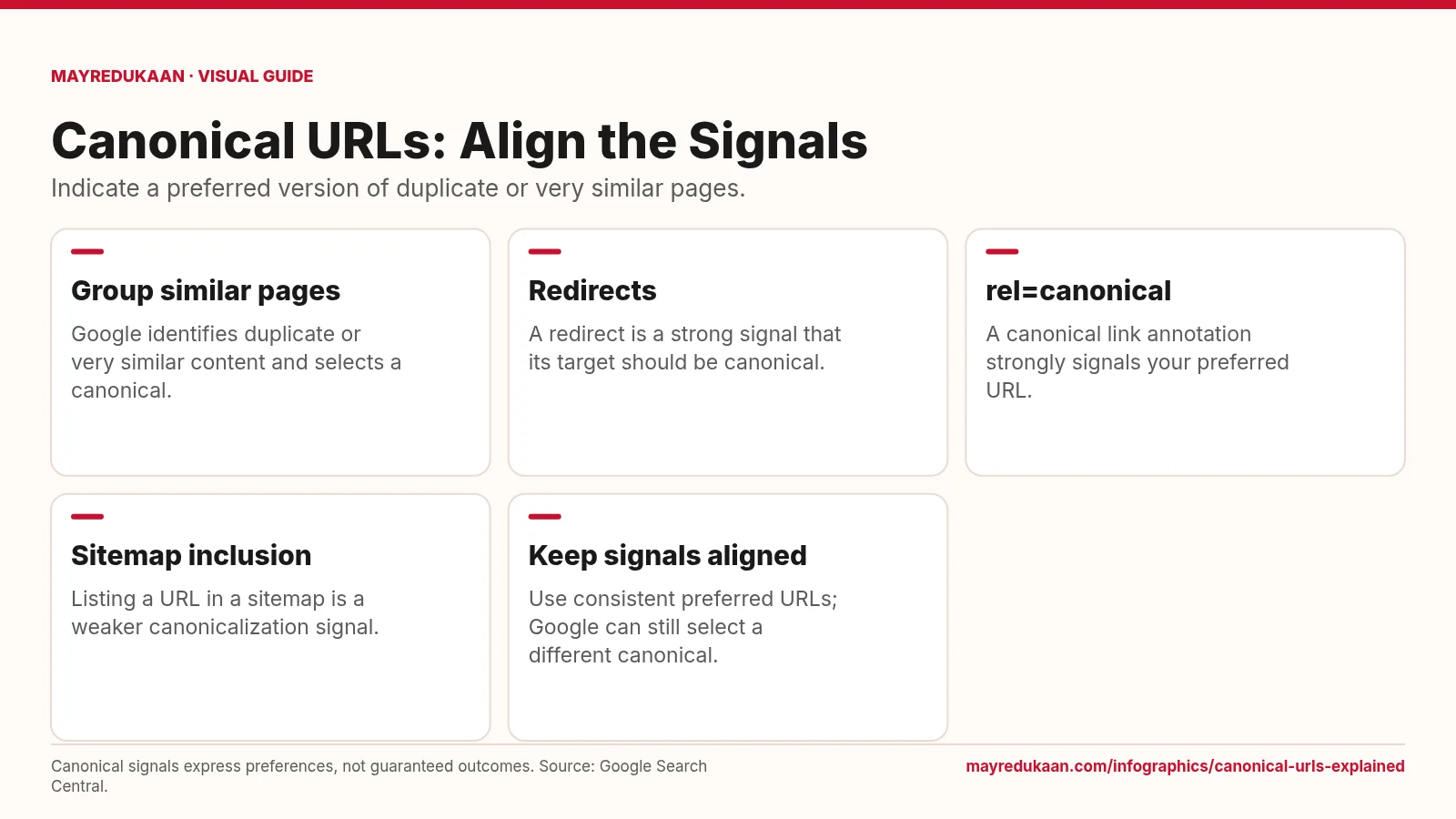
Canonical URLs Explained
Canonicalization helps Google choose a representative URL from duplicate or very similar pages.