
Strong passwords and passphrases
By MayreDukaan Research · Researched 2026-11-17
Strong passwords are not simply short words with a capital letter and an exclamation mark added. CISA recommends passwords that are long, random, and unique, with at least 16 characters as its practical public guidance. A passphrase can satisfy the same goal when it uses unrelated words rather than a familiar quotation or personal information. The important distinction is how unpredictable the choice is, not whether the result looks complicated.
NIST SP 800-63B-4 sets requirements for authentication services, rather than prescribing one universal rule for every consumer account. It requires a minimum of 15 characters for passwords used as a single factor and permits a minimum of eight when the password is only part of multifactor authentication. This graphic uses CISA's straightforward consumer advice while keeping those different purposes separate.
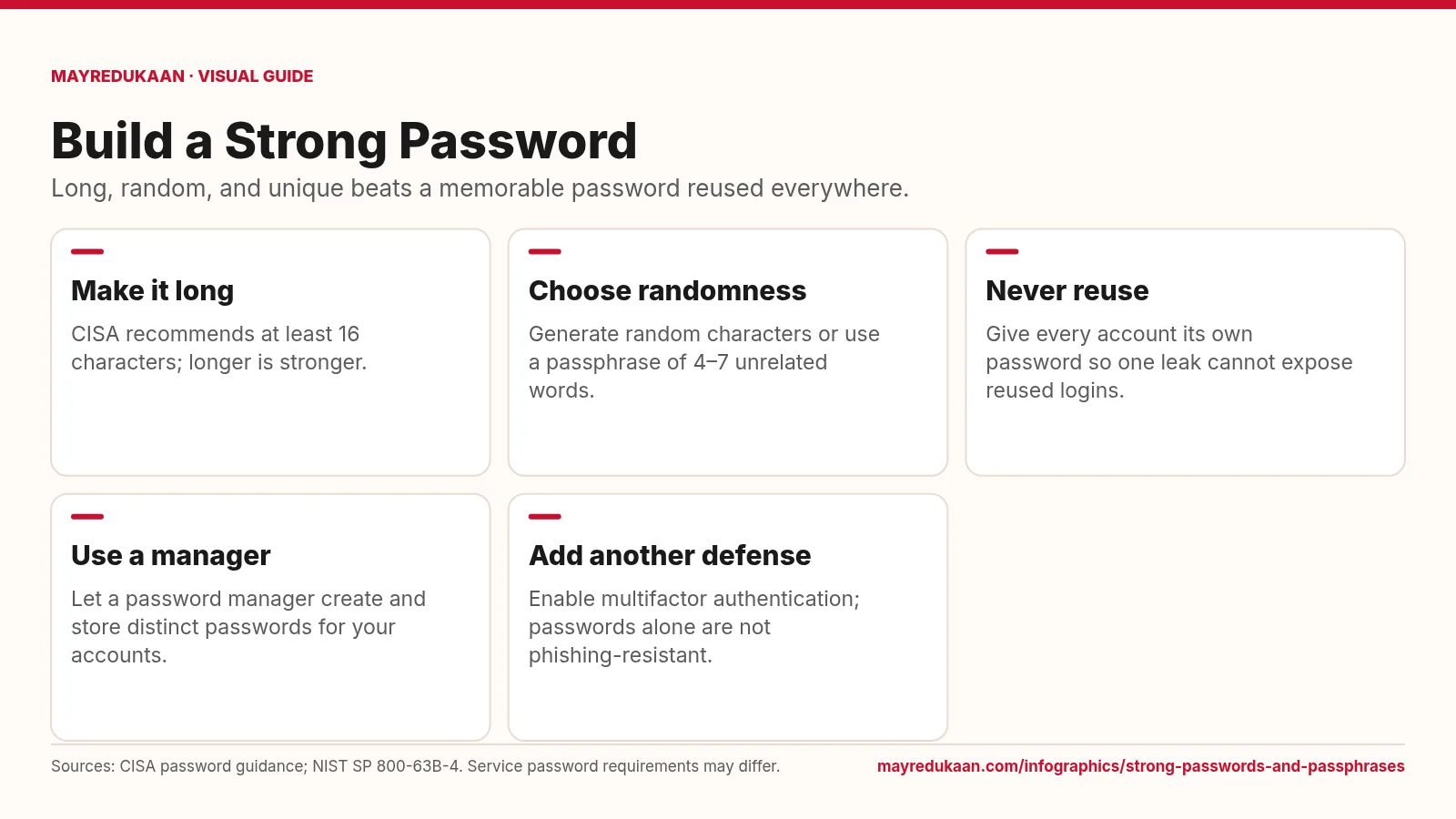
What the diagram shows
- Make it long: CISA recommends at least 16 characters; longer is stronger.
- Choose randomness: Generate random characters or use a passphrase of 4–7 unrelated words.
- Never reuse: Give every account its own password so one leak cannot expose reused logins.
- Use a manager: Let a password manager create and store distinct passwords for your accounts.
- Add another defense: Enable multifactor authentication; passwords alone are not phishing-resistant.
Sources: CISA password guidance; NIST SP 800-63B-4. Service password requirements may differ.
Start with length and unpredictable selection
The first two cards work together: make the password long and choose its contents unpredictably. CISA recommends at least 16 characters and describes two approaches: a random string of letters, numbers, and symbols, or a passphrase containing four to seven unrelated words. Do not copy a published example into an actual account. A phrase based on your birthday, pets, or other identifying information does not follow the same advice. NIST also requires services to check proposed passwords against a blocklist of commonly used, expected, or compromised values, rather than relying on appearance alone.
Keep each account separate with a manager
The third card says never to reuse passwords, and the fourth supplies a practical way to achieve that goal. If the same secret protects several accounts, its exposure at one service can put the other accounts at risk. CISA therefore recommends a different strong password for every account and a password manager to create and store those credentials. This is not a reason to memorize dozens of random strings. It is a reason to move the generation and storage work into a suitable manager while taking care to protect access to that manager itself.
Add protection without ritual password changes
The final card adds multifactor authentication because even a long password can be disclosed to a fraudulent website. NIST does not classify passwords as phishing-resistant, so length alone cannot solve that problem. Its guidance also says services must not require periodic password changes without evidence of compromise, and must require a change when compromise is evident. That differs from repeatedly changing a predictable password on a calendar. Prioritize unique credentials, respond when a password is exposed, and enable a stronger sign-in method where available rather than treating a symbol substitution as a complete security strategy.
Key facts
- CISA recommends passwords of at least 16 characters.
- CISA describes a passphrase as an option using four to seven unrelated words.
- NIST requires at least 15 characters for passwords used as a single authentication factor.
- NIST prohibits mandatory composition rules that require mixtures of character types.
- NIST requires password changes when there is evidence that the authenticator is compromised.
Frequently asked questions
Is a passphrase automatically secure?
No; CISA recommends unrelated words, sufficient length, and a different password for every account, not personal details or predictable phrases.
Do NIST and CISA give the same length rule?
No; CISA recommends at least 16 characters to the public, while NIST requires at least 15 for single-factor passwords and permits eight within MFA.
Should I change every password every month?
NIST says services must not require periodic changes without evidence of compromise, but must require a change if compromise is evident.
Related free tools
Related comparisons
Sources
- CISA: Use Strong Passwords — accessed 2026-11-17
- NIST SP 800-63B-4: Authenticator and Verifier Requirements — accessed 2026-11-17
- CISA: Turn On MFA — accessed 2026-11-17
More visual guides
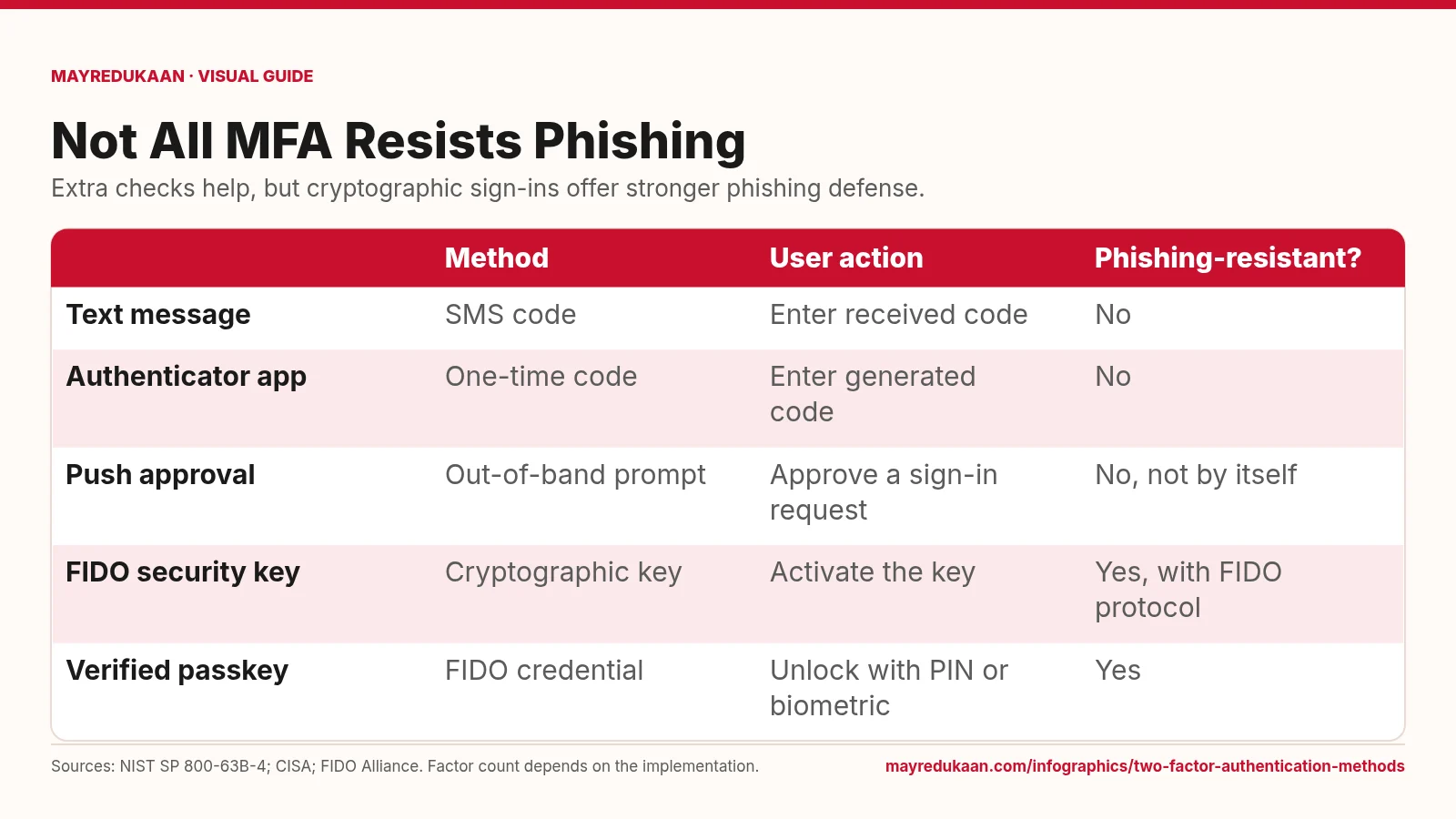
Two-factor authentication methods
Codes add a hurdle, while FIDO authentication binds the sign-in to the legitimate service.
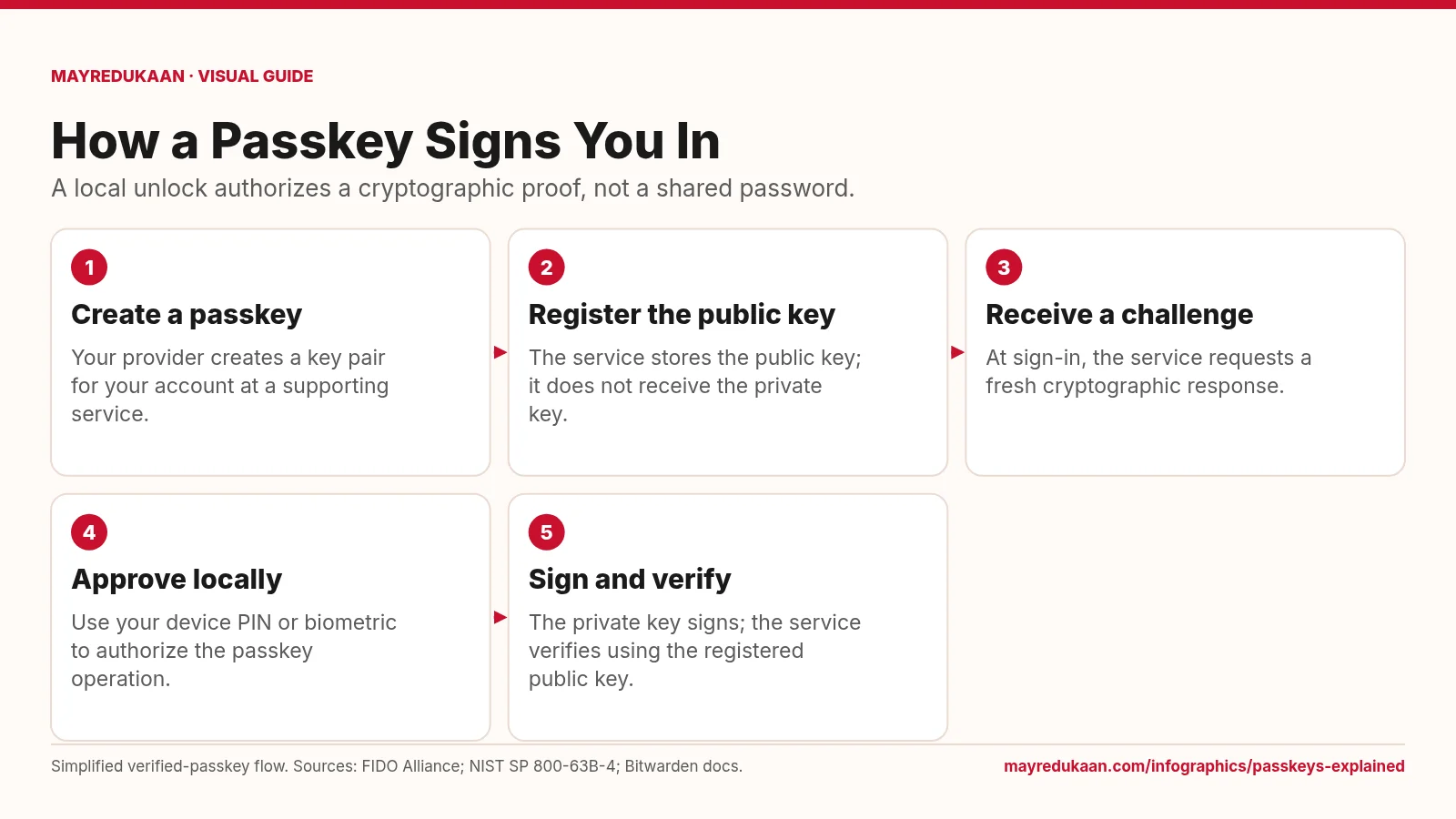
Passkeys explained
The service checks a cryptographic response while the private key remains with the user's passkey system.
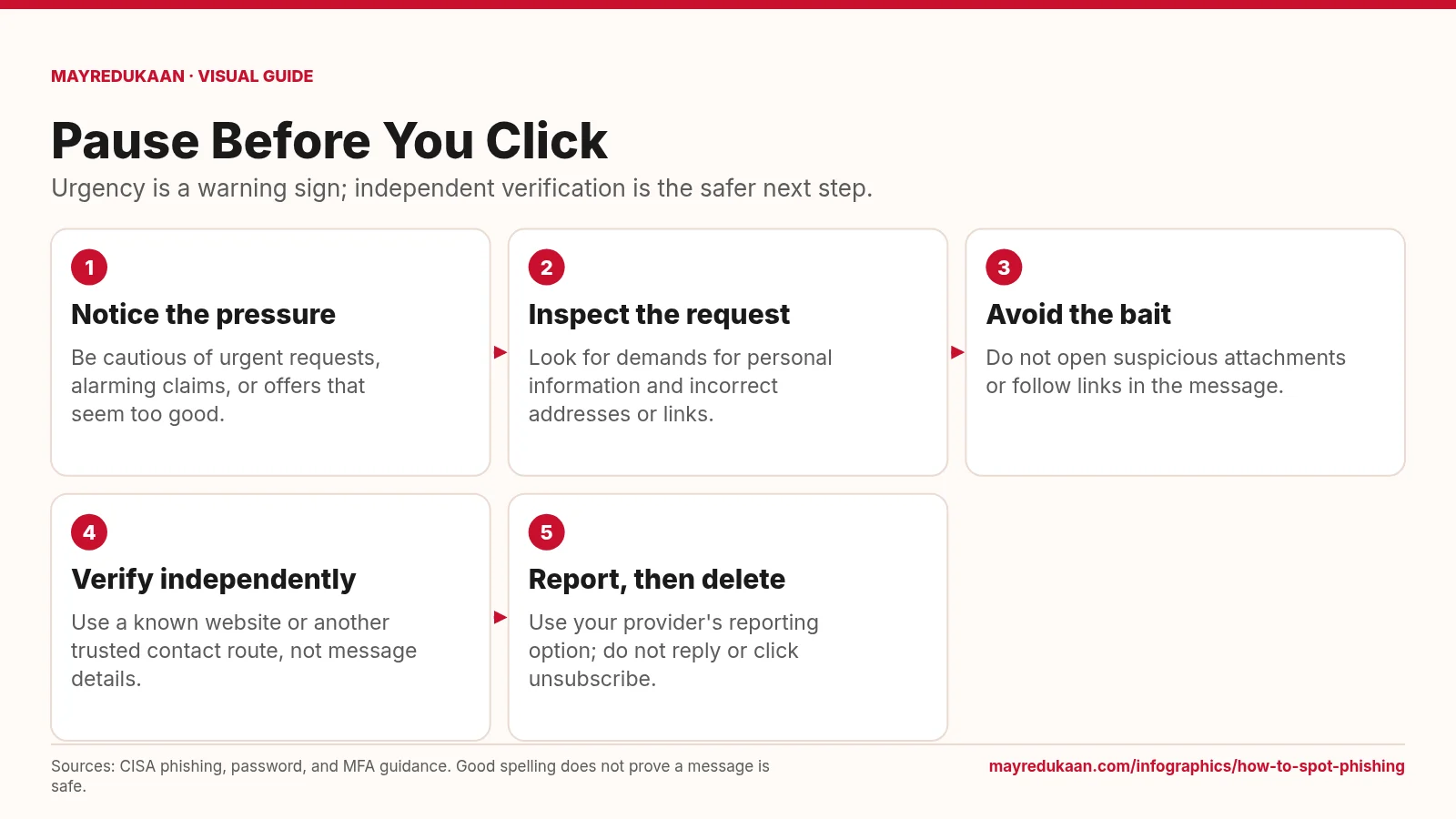
How to spot phishing
Treat suspicious messages as prompts to verify elsewhere, not instructions to act immediately.