
Two-factor authentication methods
By MayreDukaan Research · Researched 2026-11-17
Two-factor authentication uses two different factor types, such as something you know and something you have. Multifactor authentication is the broader term for using more than one factor. A password followed by another password does not supply that distinction. The second step should add a different kind of evidence rather than just another secret that works in the same way.
The methods in this comparison do not provide identical protection. SMS codes, generated one-time codes, and ordinary approval prompts can improve on a password alone, but they do not inherently stop a fraudulent site from relaying the login. NIST distinguishes those methods from phishing-resistant cryptographic authentication. FIDO security keys and passkeys can provide that stronger property, although the number of factors still depends on whether local user verification is required.
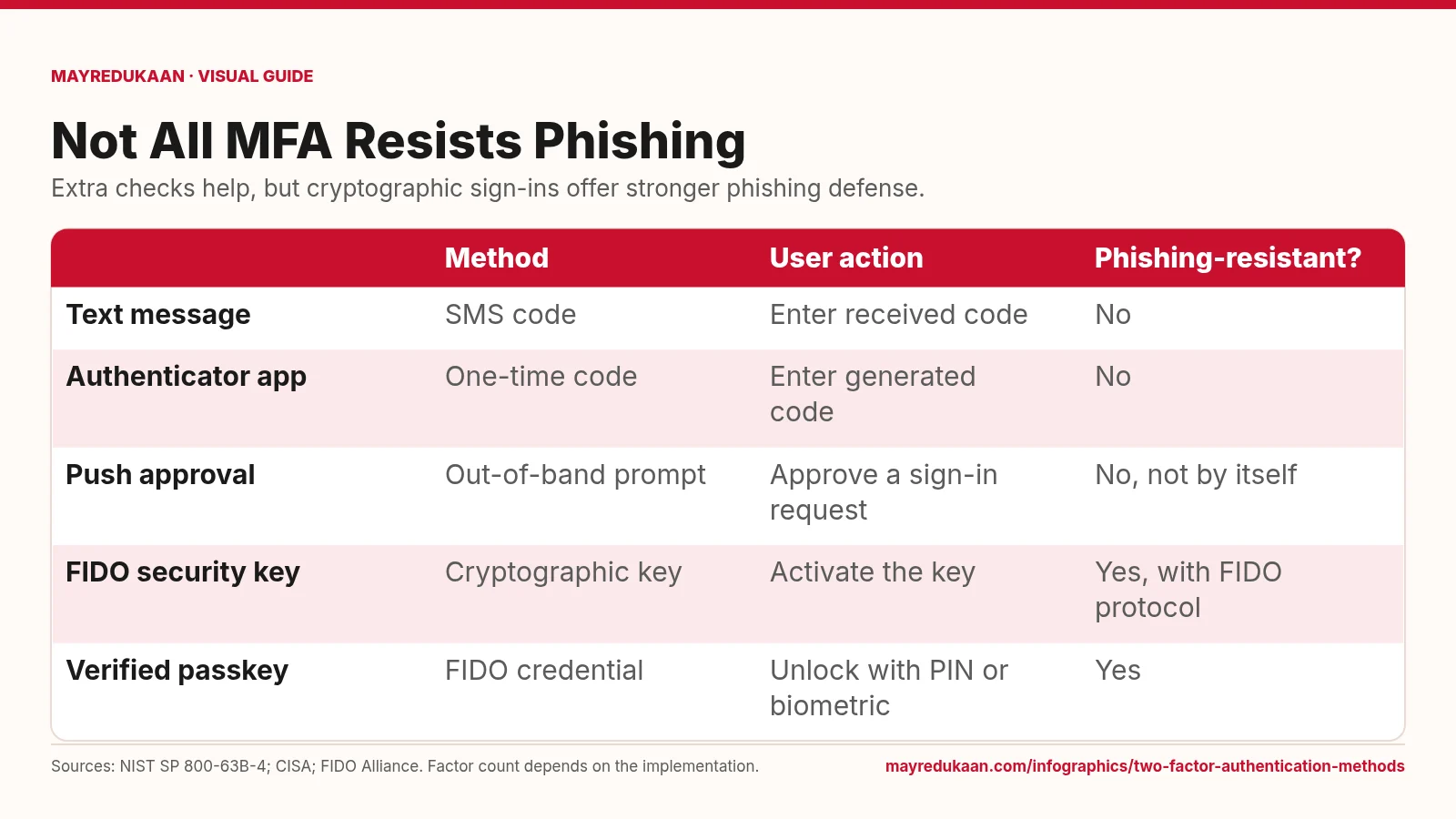
What the diagram shows
| Method | User action | Phishing-resistant? | |
|---|---|---|---|
| Text message | SMS code | Enter received code | No |
| Authenticator app | One-time code | Enter generated code | No |
| Push approval | Out-of-band prompt | Approve a sign-in request | No, not by itself |
| FIDO security key | Cryptographic key | Activate the key | Yes, with FIDO protocol |
| Verified passkey | FIDO credential | Unlock with PIN or biometric | Yes |
Sources: NIST SP 800-63B-4; CISA; FIDO Alliance. Factor count depends on the implementation.
Read the code-based rows
The first row shows a text message: the user receives a code and types it into the sign-in page. The second shows an authenticator app that generates a one-time code. Both can prove access to an additional authenticator when combined with a password, but neither makes the page receiving the code trustworthy. NIST states that manually entered authenticator outputs are not phishing-resistant because the output is not bound to the specific authentication session. Its guidance also treats use of the public telephone network for out-of-band authentication as restricted, requiring additional consideration rather than assuming SMS is the strongest available choice.
Distinguish approval prompts from FIDO proofs
The third row covers an ordinary push approval, where a device asks the user to authorize a login. That prompt is not, by itself, phishing-resistant cryptographic authentication. The next two rows instead use FIDO credentials. A FIDO security key performs a cryptographic operation, while a verified passkey combines a FIDO credential with local verification such as a PIN or biometric. These methods bind authentication to the legitimate service rather than asking the user to transfer a reusable password or manually entered code to whatever page happens to be open in the browser.
Choose a method and understand its factor count
CISA recommends enabling MFA on accounts that offer it, and the comparison should not be read as a reason to leave MFA disabled when a preferred method is unavailable. Use the account's security settings to review the offered options. At the same time, do not assume every security key interaction proves two factors. NIST distinguishes single-factor cryptographic authenticators from multifactor cryptographic authenticators that require a memorized or biometric activation factor. A passkey with user verification can satisfy that multifactor model in one sign-in interaction, without necessarily requiring a separate password and a separately typed code.
Key facts
- MFA requires more than one distinct authentication factor type.
- NIST does not consider manually entered one-time codes phishing-resistant.
- NIST treats telephone-network out-of-band authentication as restricted.
- FIDO credentials use public-key cryptography for phishing-resistant authentication.
- A cryptographic authenticator's factor count depends on whether an activation factor is required.
Frequently asked questions
Are two passwords two factors?
No; both are knowledge secrets, so they do not represent two different factor types.
Can a fake website steal an authenticator code?
Yes; a manually entered code can be captured and relayed during its validity period, so it is not phishing-resistant.
Can a passkey replace password-plus-code login?
Yes; a FIDO passkey with local user verification can provide multifactor authentication within one sign-in interaction.
Sources
- NIST SP 800-63B-4: Authenticator and Verifier Requirements — accessed 2026-11-17
- CISA: Turn On MFA — accessed 2026-11-17
- FIDO Alliance: Passkeys — accessed 2026-11-17
More visual guides
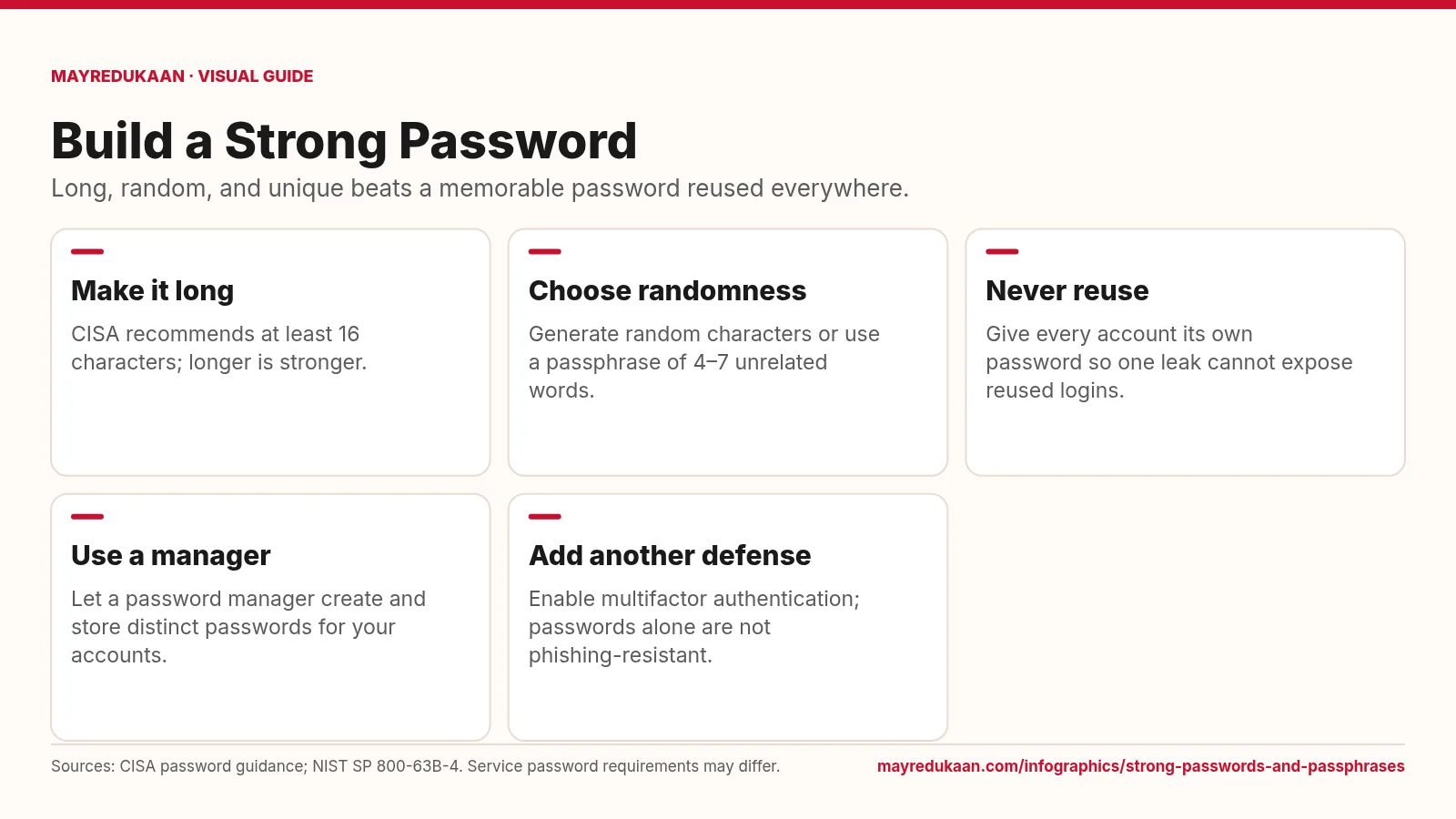
Strong passwords and passphrases
A strong password combines length, unpredictable selection, and exclusive use on one account.
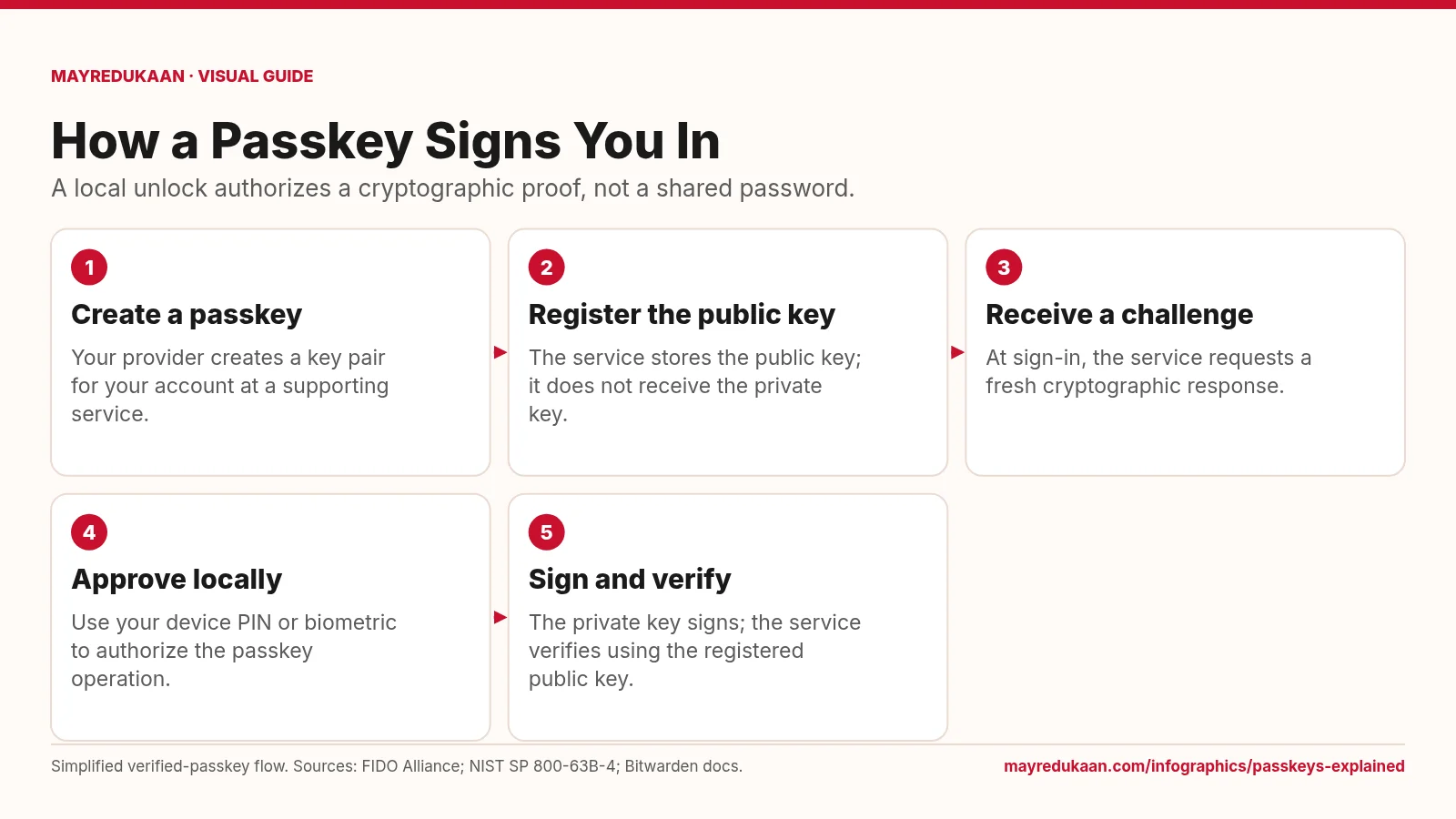
Passkeys explained
The service checks a cryptographic response while the private key remains with the user's passkey system.
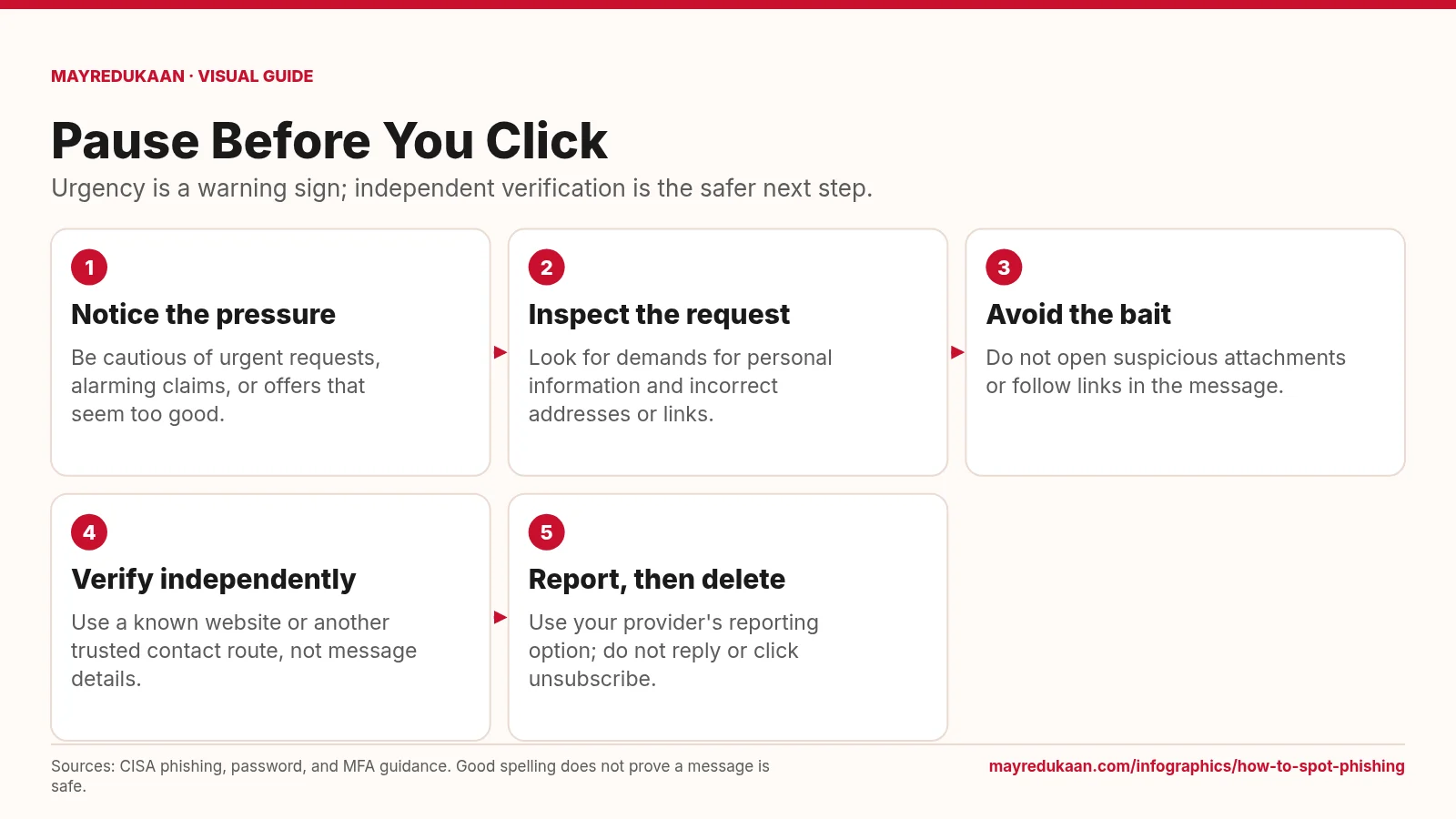
How to spot phishing
Treat suspicious messages as prompts to verify elsewhere, not instructions to act immediately.