
Structured Data Explained
By MayreDukaan Research · Researched 2026-11-17
Structured data is a standardized way to describe information on a page and classify its content. For example, recipe markup can identify ingredients and cooking information as specific properties rather than leaving Google to infer everything from ordinary text. Google uses structured data to understand pages, and supported markup can make a page eligible for richer search appearances.
Eligibility is not the same as a guaranteed rich result. The markup must match the actual page, satisfy the relevant feature requirements, and follow Google's general structured data policies. A successful validation result does not settle every quality or display decision. The flow therefore ends with eligibility rather than a promised enhancement, ranking gain, or traffic outcome, and it places accurate content and crawler access alongside code correctness.
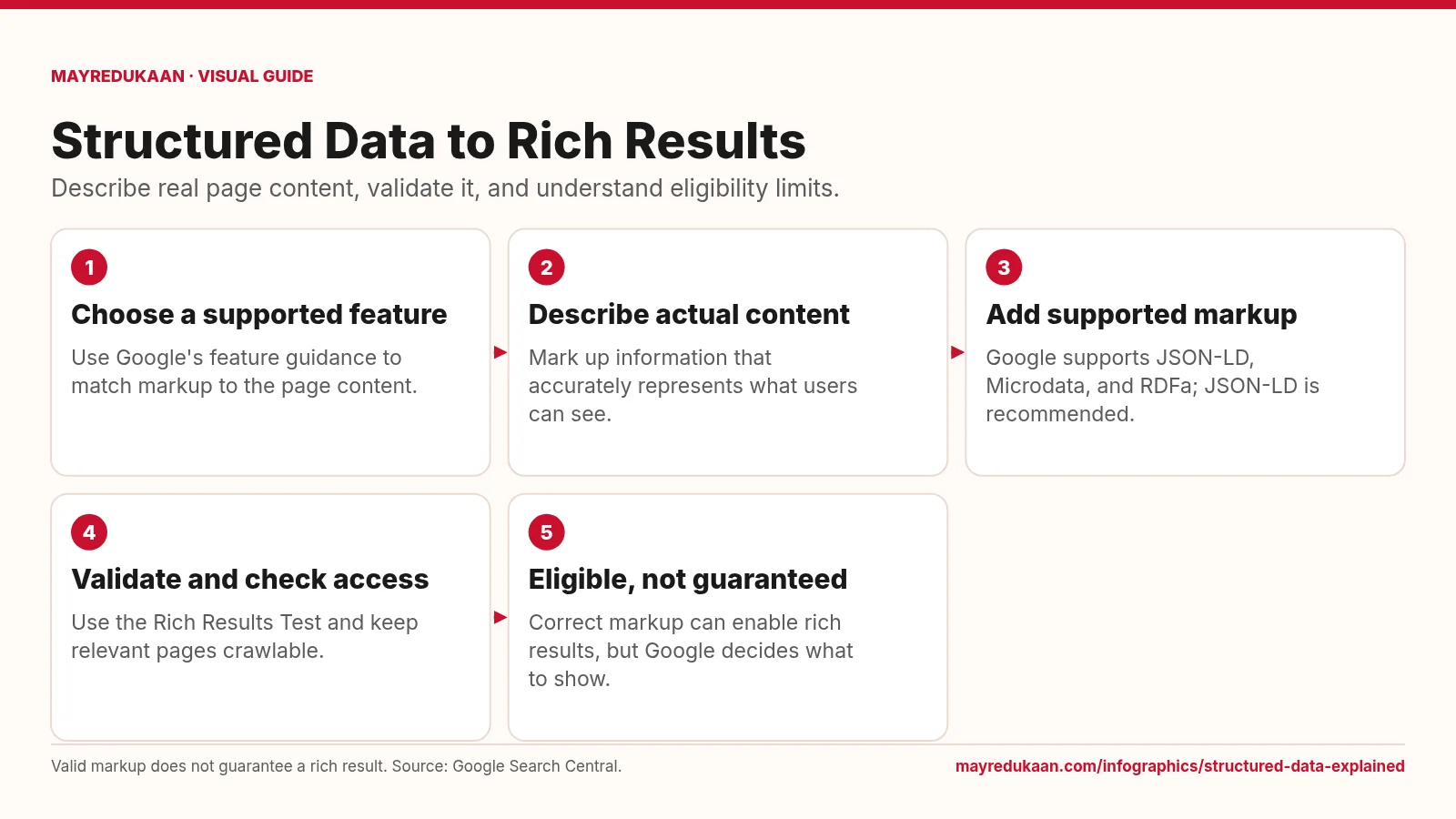
What the diagram shows
- Choose a supported feature: Use Google's feature guidance to match markup to the page content.
- Describe actual content: Mark up information that accurately represents what users can see.
- Add supported markup: Google supports JSON-LD, Microdata, and RDFa; JSON-LD is recommended.
- Validate and check access: Use the Rich Results Test and keep relevant pages crawlable.
- Eligible, not guaranteed: Correct markup can enable rich results, but Google decides what to show.
Valid markup does not guarantee a rich result. Source: Google Search Central.
Choose the feature and describe real content
The first two steps start with content rather than code. Consult Google's supported search-feature guidance and choose markup that matches what the page actually contains. Structured data labels information explicitly, but it must not invent facts or describe misleading content that users cannot find on the page. For a recipe, for instance, the structured properties should describe the recipe being presented. Google's general policies require representative, relevant markup, and feature-specific documentation defines additional required properties. Merely finding a vocabulary term does not establish that Google supports a corresponding rich-result feature for that page or use case.
Implement a supported format and test the page
The third step lists the formats Google supports: JSON-LD, Microdata, and RDFa. Google recommends JSON-LD, while acknowledging that the appropriate implementation can depend on the setup. The fourth step adds testing and access checks. Use Google's Rich Results Test to check supported structured data and review the requirements for the selected feature. Google must also be able to access the relevant page, so robots.txt blocks, noindex, or login requirements can interfere with rich-result eligibility. Validation helps catch implementation problems, but Google's policies explain that not every quality issue can be detected by an automated test.
Interpret eligibility without promising a display
The final step deliberately says eligible rather than guaranteed. Google does not promise to show a rich result simply because markup is correct and a testing tool reports no relevant errors. Its systems decide which presentation is useful for a particular search, and policy or quality considerations still apply. That distinction separates technical validation from actual search appearance. The diagram therefore should not be read as a conversion funnel with a certain final outcome. Treat structured data as an accurate description of supported content, maintain it as the page changes, and assess display separately from whether the code is syntactically valid.
Key facts
- Structured data provides explicit information about a page and classifies its content.
- Google supports JSON-LD, Microdata, and RDFa for structured data.
- Google recommends JSON-LD for structured data implementations.
- Structured data must accurately represent the page content.
- Passing a validation test does not guarantee a rich result.
- Google's feature-specific requirements apply alongside its general structured data policies.
Frequently asked questions
Does valid structured data guarantee a rich result?
No; correct markup can support eligibility, but Google decides whether a rich result is appropriate to display.
Which markup format does Google recommend?
Google recommends JSON-LD and also supports Microdata and RDFa.
Can I mark up information that is absent from the page?
No; markup must accurately represent the page content rather than describe hidden, irrelevant, or misleading information.
Is every schema type a Google rich-result feature?
No; consult Google's supported-feature gallery and the specific feature documentation to identify eligible implementations.
Related free tools
Sources
- Introduction to structured data markup in Google Search — accessed 2026-11-17
- General structured data guidelines — accessed 2026-11-17
- Explore the search gallery — accessed 2026-11-17
More visual guides
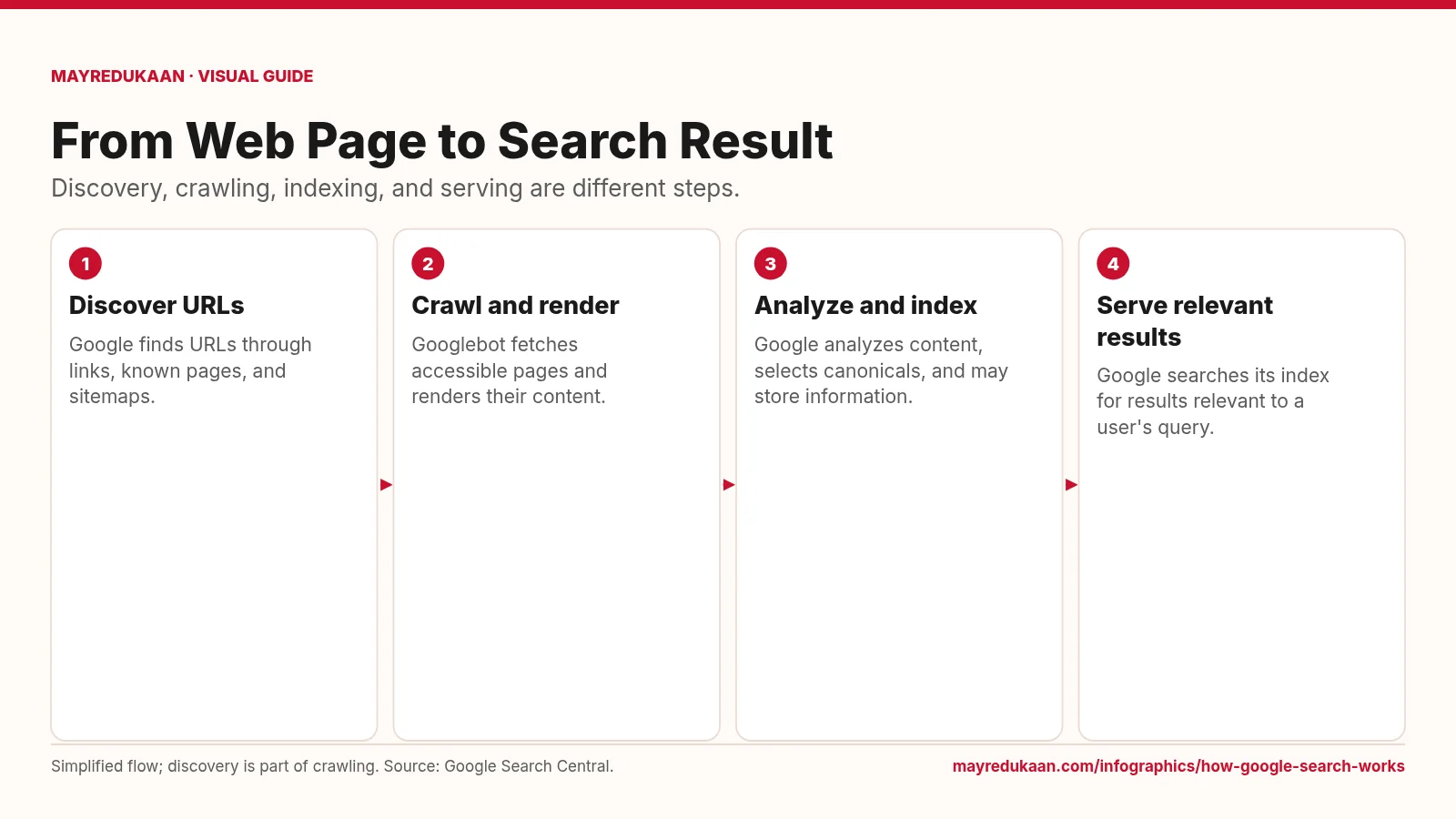
How Google Search Works
A page must be discovered and processed before its information can compete to appear for a search.
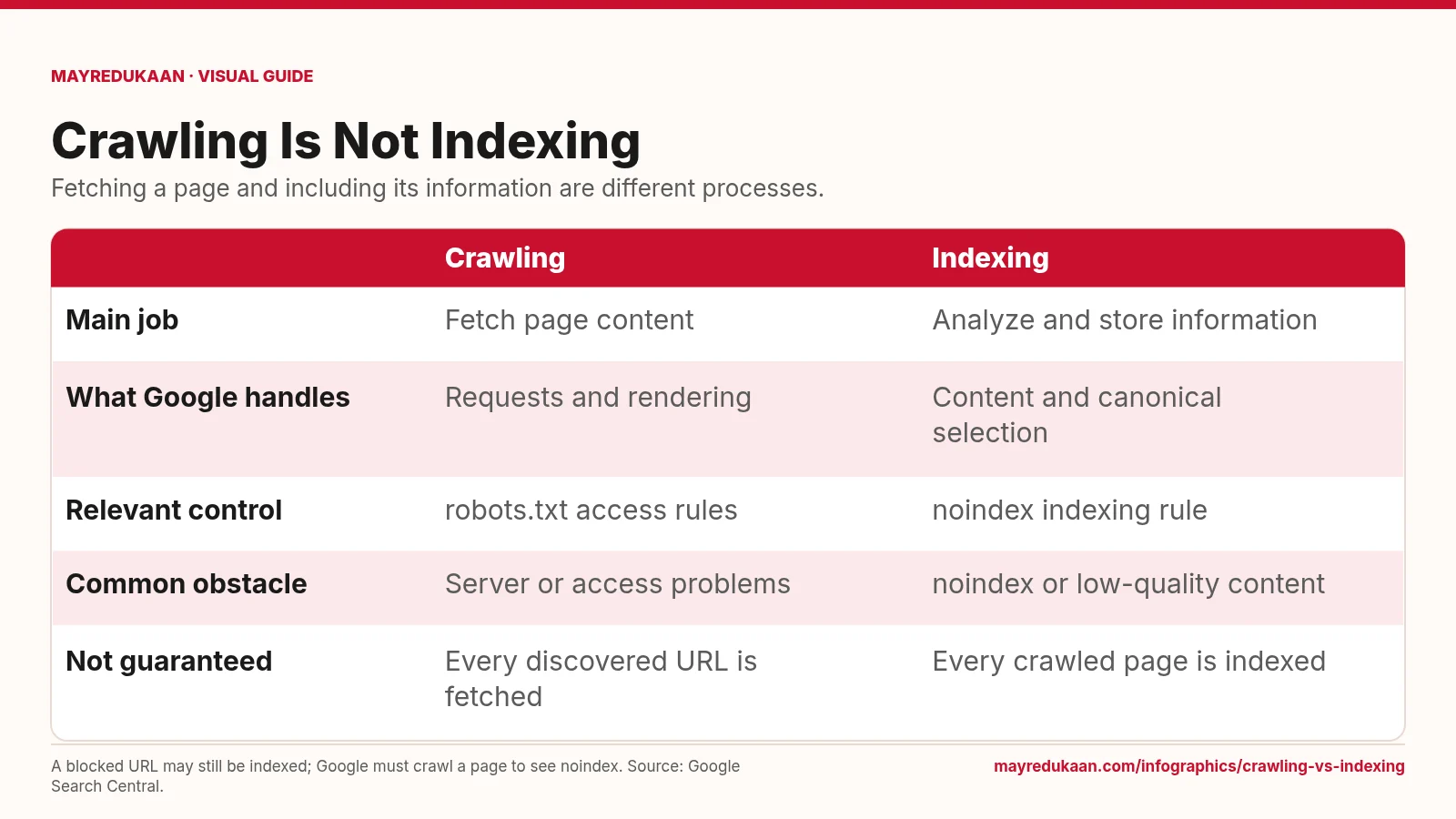
Crawling vs Indexing
Use crawl controls for fetching and indexing rules for whether content belongs in Search.
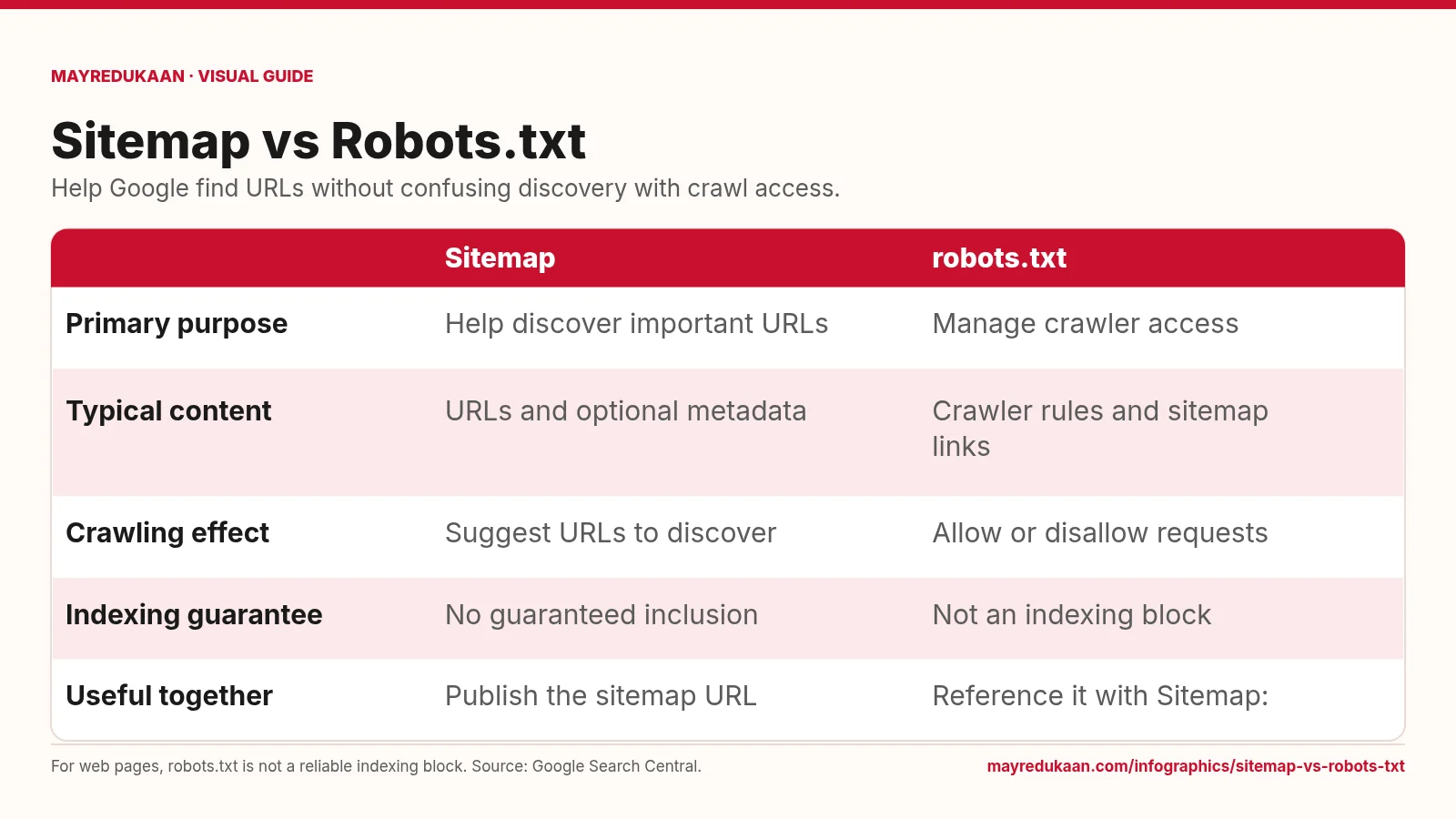
Sitemap vs Robots.txt
Sitemaps support URL discovery, while robots.txt sets crawl-access rules for compliant crawlers.