
Title Tags and Meta Descriptions
By MayreDukaan Research · Researched 2026-11-17
A page's title element and meta description help describe its content, but they are not identical to the text Google displays in search results. Google generates title links automatically from several sources, including the title element and prominent page text. Snippets are generated primarily from page content, and Google may use a meta description when it provides a better description of the page.
This means you should write useful, accurate metadata without assuming the wording will always appear unchanged. The comparison separates each HTML field from the search feature it may influence. It also avoids treating popular character-count targets as Google's technical limits: Google's guidance specifies no fixed length limit for these fields, while visible text may be truncated to fit the device's available width.
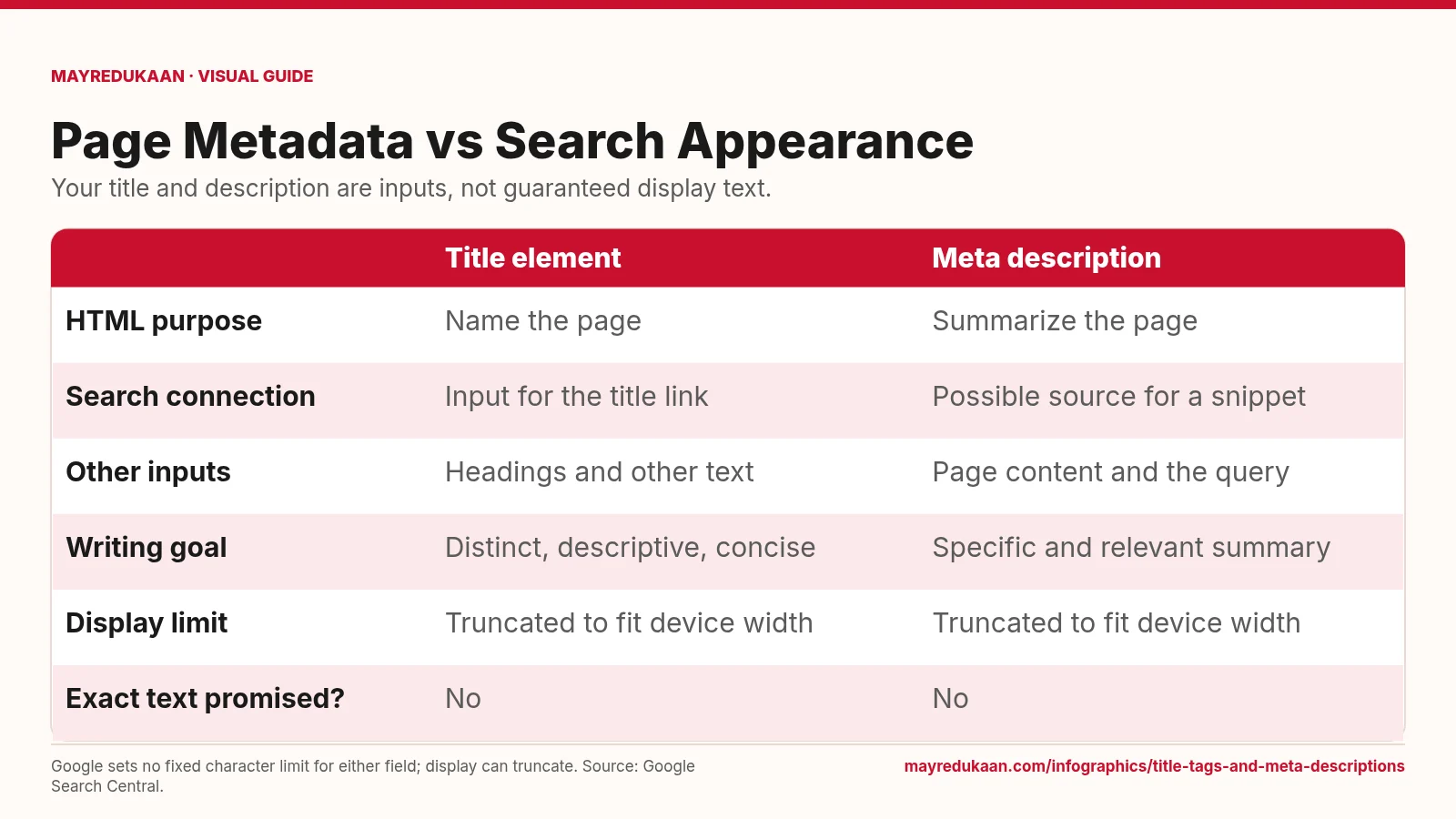
What the diagram shows
| Title element | Meta description | |
|---|---|---|
| HTML purpose | Name the page | Summarize the page |
| Search connection | Input for the title link | Possible source for a snippet |
| Other inputs | Headings and other text | Page content and the query |
| Writing goal | Distinct, descriptive, concise | Specific and relevant summary |
| Display limit | Truncated to fit device width | Truncated to fit device width |
| Exact text promised? | No | No |
Google sets no fixed character limit for either field; display can truncate. Source: Google Search Central.
Separate the HTML fields from search features
The first two rows distinguish what you publish from what Google displays. The title element names the page and is one source Google can use for the clickable title link in a search result. The meta description provides a summary and may supply a result's descriptive snippet. Neither field is a template that Google promises to reproduce verbatim. This distinction matters when comparing source HTML with a live result: a difference does not automatically mean the HTML is broken. Google's systems construct the visible search presentation using the available sources and their understanding of the page.
Account for other inputs and write for the page
The other-inputs row explains why display text can differ. Title links can draw on headings and other text, while snippets come primarily from page content and can change according to the query. The writing-goal row translates that into practical guidance: use a distinct, descriptive, concise title and a specific description that genuinely summarizes the page. Avoid repeated boilerplate and keyword stuffing. If the page changes substantially, keep the metadata consistent with its current content. A clear summary gives Google a useful candidate, but it does not prevent another passage from better answering a particular search.
Treat width and rewriting as display realities
The final two rows address length and exact wording. Google's documentation does not define a fixed character limit for a title element or meta description. Instead, title links and snippets can be truncated to fit the available device width. A character-count preview can help with editing, but it is not a guarantee of identical rendering in every result. Google may also select different wording rather than simply cutting off the supplied text. Put the most useful identifying information into clear, natural language, then evaluate whether the title and description accurately represent the page rather than chasing a supposedly universal character threshold.
Key facts
- Google generates title links automatically using several sources.
- The title element is one source used to generate a title link.
- Google creates snippets primarily from page content.
- A meta description may be used when it describes the page better than available page text.
- Google specifies no fixed character limit for title elements or meta descriptions.
- Visible title links and snippets can be truncated to fit device width.
Frequently asked questions
Will Google always show my meta description?
No; Google primarily generates snippets from page content and may use the meta description when it is a better summary.
Is there a guaranteed title character count that always fits?
No; display depends on available width, and Google may truncate or generate different title-link text.
Can the same page show different snippets?
Yes; snippets can vary with the query so that the description better matches what the user searched for.
Related free tools
Sources
- Influencing your title links in search results — accessed 2026-11-17
- Control your snippets in search results — accessed 2026-11-17
- SEO Starter Guide — accessed 2026-11-17
More visual guides
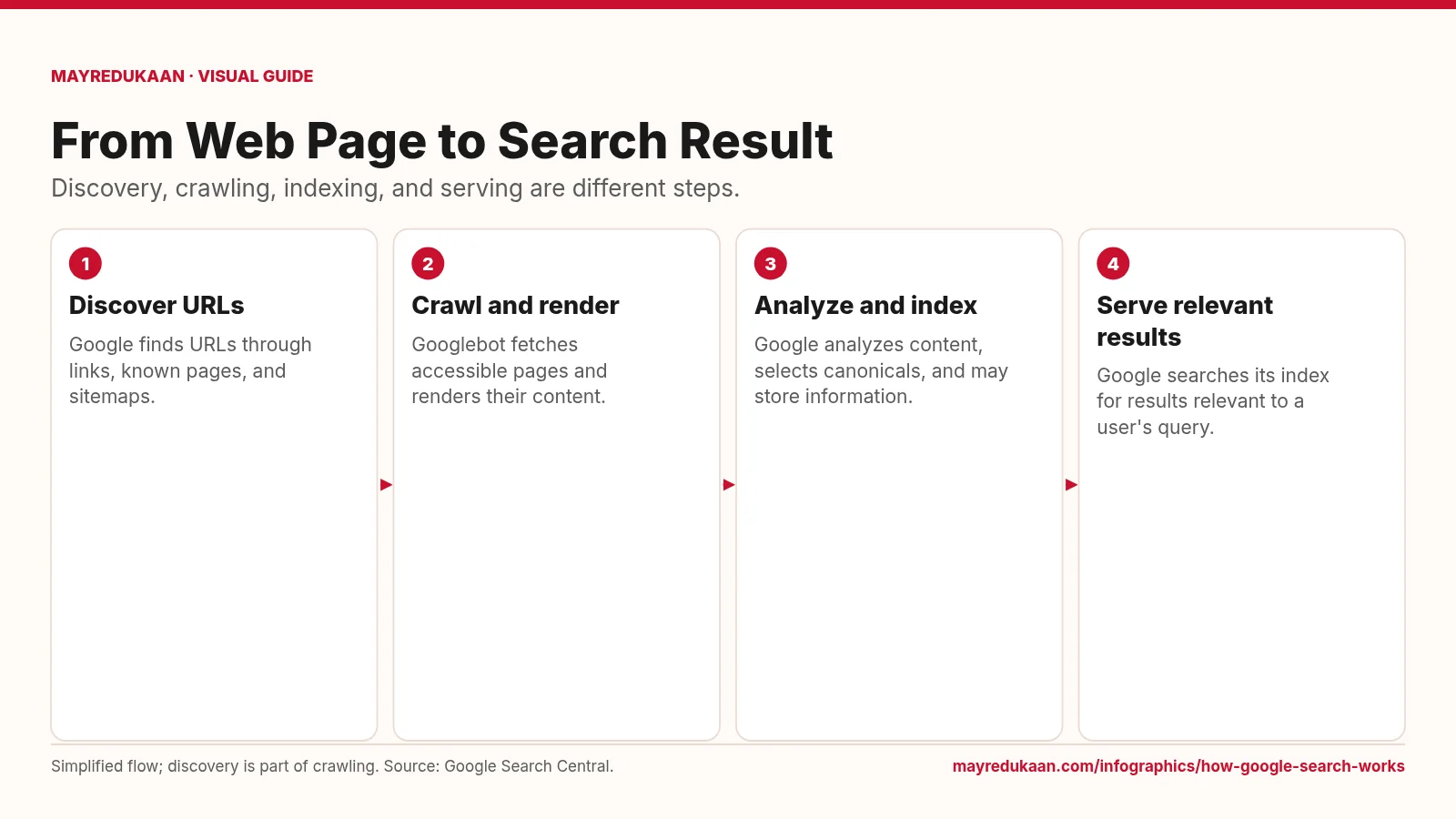
How Google Search Works
A page must be discovered and processed before its information can compete to appear for a search.
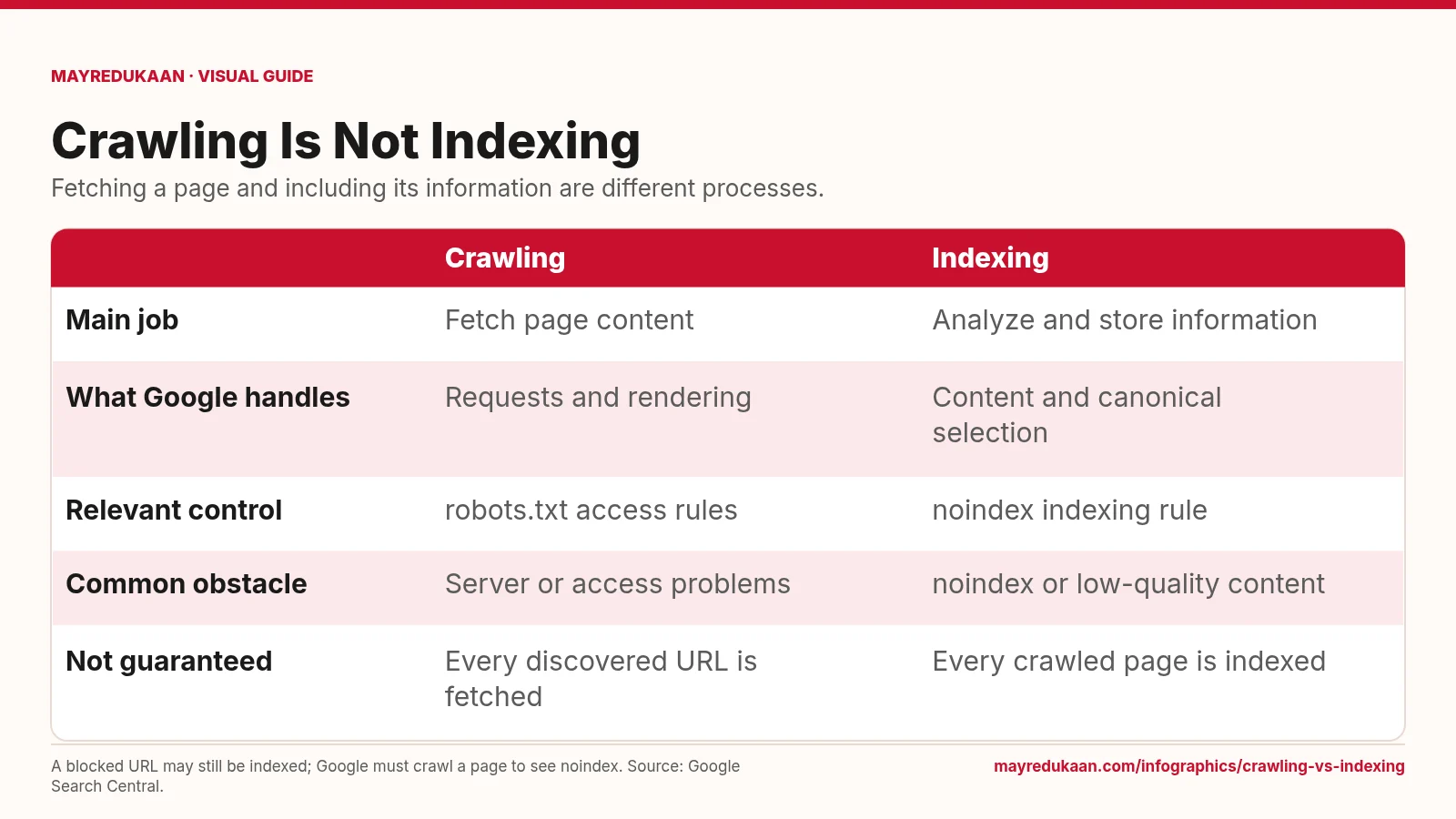
Crawling vs Indexing
Use crawl controls for fetching and indexing rules for whether content belongs in Search.
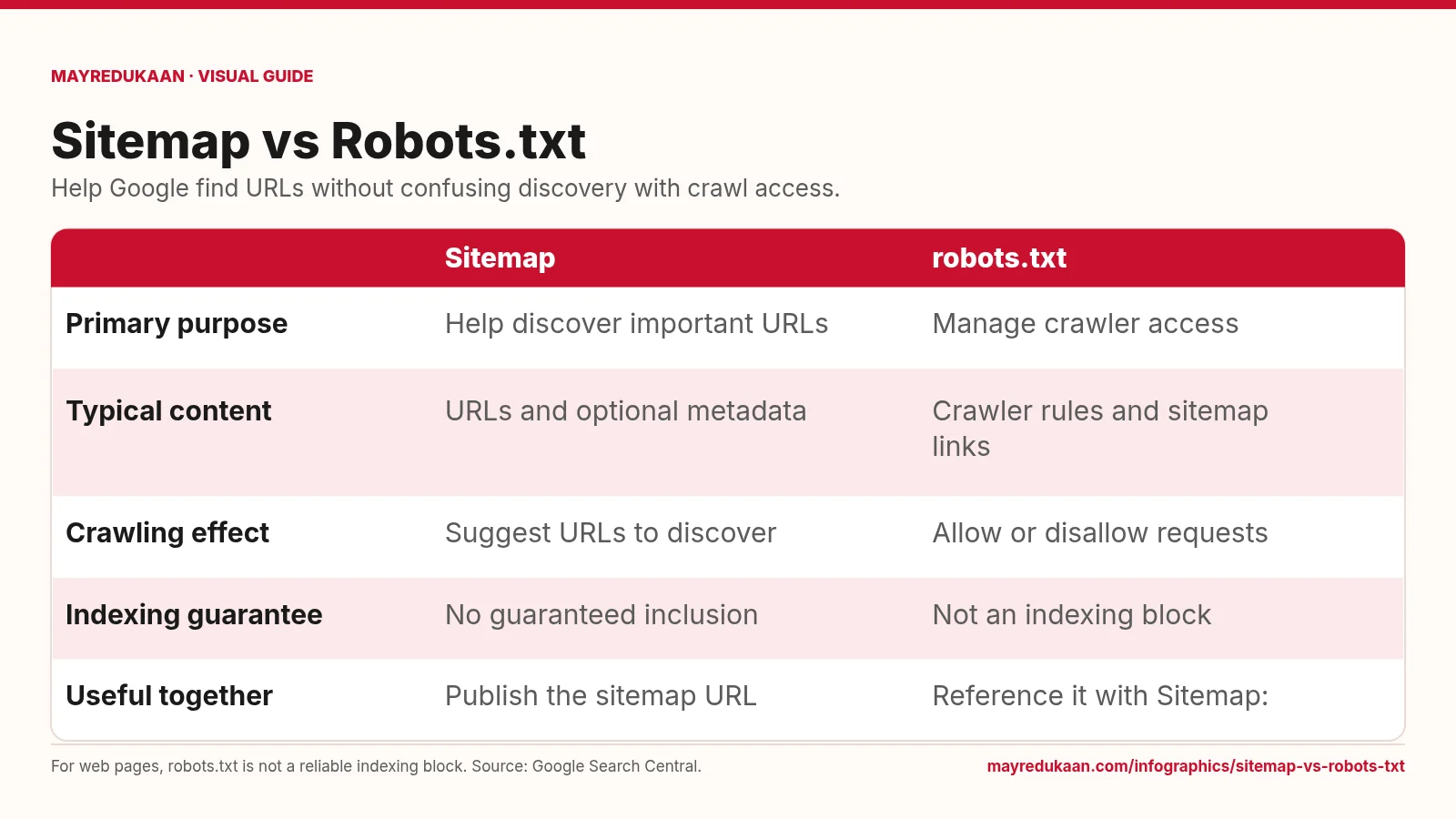
Sitemap vs Robots.txt
Sitemaps support URL discovery, while robots.txt sets crawl-access rules for compliant crawlers.